
Gyirong Port Mudslide Kills 16, Leaves 546 Missing as Rescuers Face Secondary Flood Risks
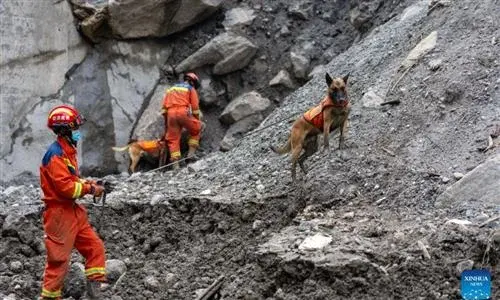
A massive mudslide triggered by an ice-rock avalanche from Nepal has devastated the Gyirong border port in China's Tibet region. As of August 30, 2026, the disaster has killed 16 people and left 546 missing on the Chinese side. Rescue operations are underway using heavy machinery, drones, and sniffer dogs, but teams face severe time pressures due to the rapid onset of the debris flow and the risk of a new landslide-dammed lake bursting nearby.
Key points
- The disaster began on August 26, 2026, when a glacier collapse in Nepal sent ice and rock avalanches into the Cuoqian River, accelerating down approximately 20 kilometers to hit Gyirong Port in about seven minutes.
- Official figures report 16 deaths and 546 missing persons on the Chinese side of the border, with rescue teams utilizing 3D scanners, drones, and military personnel to search the debris.
- A new lake formed by the landslide was detected on August 30, posing an immediate risk of bursting and complicating rescue efforts.
- Gyirong is a critical trade hub, handling 30% of China-Nepal trade, with 95% of goods in 2024 being Chinese exports, including 4,200 electric cars.
- The area has experienced repeated hazards, including a bridge collapse in July 2025 and a glacial lake outburst in January 2026 that killed 11 people.
Background
This incident follows a pattern of severe hydrological and geological risks in the Himalayan region. In January 2026, a glacial lake outburst in the Donglin Zangbo basin, 15 kilometers upstream from Gyirong, killed 11 people and left 29 missing. Prior to that, floods in July 2025 destroyed the bridge linking Gyirong to Rasuwa, Nepal, halting all cross-border movement until January 2026. These events highlight the fragility of infrastructure in this high-altitude corridor, which is central to regional trade and strategic connectivity.
How outlets are covering it
Xinhua and Global Times emphasize the urgency of the rescue operation, highlighting the use of advanced technology like 3D scanners and the heroic efforts of firefighters and military personnel against the odds. Le Monde frames the disaster as a strategic setback for Beijing, noting that Gyirong is a key node in the Belt and Road Initiative and a primary entry point for Chinese goods into Nepal. While Chinese state media focuses on the immediate humanitarian response and technical capabilities, Le Monde underscores the long-term vulnerability of China's infrastructure investments in the Himalayas, pointing to the repeated nature of such disasters and the recent establishment of a flood risk information-sharing mechanism between China and Nepal.
Why it matters
The Gyirong disaster underscores the extreme risks associated with infrastructure development in geologically unstable Himalayan regions. As a critical trade artery for China-Nepal commerce and a component of broader regional connectivity strategies, the destruction of this port disrupts supply chains and raises questions about the resilience of Belt and Road projects in climate-vulnerable zones. The potential for secondary hazards, such as the newly formed landslide-dammed lake, indicates that the crisis is ongoing and may lead to further loss of life and infrastructure damage.
What to watch
Rescue teams will continue searching for survivors while monitoring the stability of the new landslide-dammed lake. Authorities are likely to assess the extent of damage to roads, bridges, and buildings to plan reconstruction. The incident may accelerate the implementation of the flood risk information-sharing mechanism agreed upon by Chinese and Nepali officials in August 2026, aiming to improve early warning systems and disaster preparedness in the region.
- Rescuers race against time and odds in search of survivors in mudslide-hit Gyirong Port Global Times
- China warns of ‘major’ glacier collapse risk as landslide death toll nears 1,000 scmp.com
- Drone image shows glaciers around impact crater on Chhochen Khola River in Nepal still at risk of collapse: China’s ministry of water resources Global Times
- China Says 261 Foreigners From 23 Countries Are Missing in Tibet Flood The New York Times
- Tibet landslide undermines Xi Jinping's gamble on the Himalayas Le Monde.fr
Want the full story? Read the original reporting
Read on Global Times