
China Dominates BRICS Trade Network, Accounting for 75% of Intra-Bloc Value
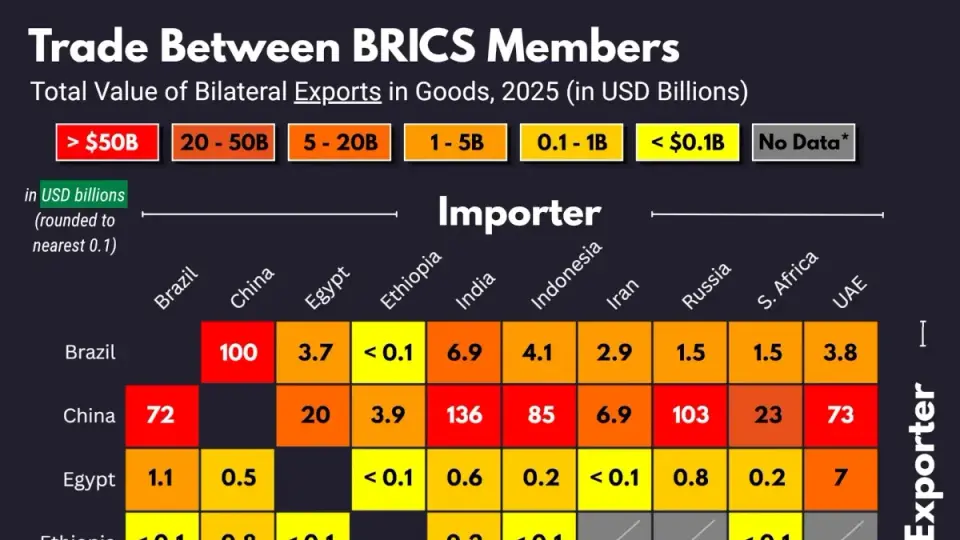
2025 data reveals that intra-BRICS trade is heavily concentrated in China, which accounts for roughly three-quarters of all bilateral trade value within the bloc. While China exports $523 billion to other members, the remaining nine members trade only $294 billion among themselves, highlighting a lopsided economic structure despite the group's push for multipolarity.
Key points
- China is the central hub of BRICS trade, with $523 billion in exports to other members and $361 billion in imports, totaling $884 billion in trade flows touching China.
- The largest single export flow is China’s $136 billion to India, followed by Russia’s $124 billion to China.
- Excluding China, the remaining nine BRICS members trade only $294 billion among themselves, less than China’s exports alone.
- Trade flows vary drastically, from over $100 billion to less than $100 million, reflecting differences in geography, infrastructure, and economic specialization.
- Intra-BRICS merchandise exports grew more than 13-fold from 2003 to $1.17 trillion in 2024, with China playing a central role.
Background
Recent BRICS summits in Delhi have emphasized resilient global trade, energy, and supply chains, with leaders pushing for non-Western cross-border payment channels and currency-based trade to reduce Western financial influence. These efforts aim to empower the Global South amid tariff frictions and geopolitical shifts, but the trade data reveals a lopsided structure dominated by China.
How outlets are covering it
Visual Capitalist and Voronoi both highlight China’s dominance in BRICS trade, but Voronoi emphasizes the lopsided nature of the bloc, noting that China accounts for nearly 75% of all bilateral trade value. Visual Capitalist focuses on the concentration of trade flows and the variation in trade sizes, while Voronoi stresses the gap between China’s trade and the rest of the bloc’s internal trade. Both sources agree that BRICS is an informal, consensus-based grouping rather than a customs union, which limits deeper integration.
Why it matters
The concentration of trade in China undermines the BRICS bloc’s goal of multipolarity and challenges Western economic dominance. It highlights the need for deeper integration and more balanced trade relationships among members to strengthen the group’s economic influence and resilience against external pressures.
What to watch
Future BRICS summits may focus on addressing trade imbalances and promoting more balanced trade relationships among members. The push for non-Western payment channels and currency-based trade could help reduce dependence on Western financial systems, but the current trade structure suggests that China will remain the central hub of the bloc’s economic activity.
- Which BRICS Countries Trade the Most With Each Other? Visual Capitalist
- Trade Between BRICS Members Voronoi by Visual Capitalist
Want the full story? Read the original reporting
Read on Visual Capitalist