
Hungary Sinks Barges to Lift Danube Levels and Save Paks Nuclear Plant
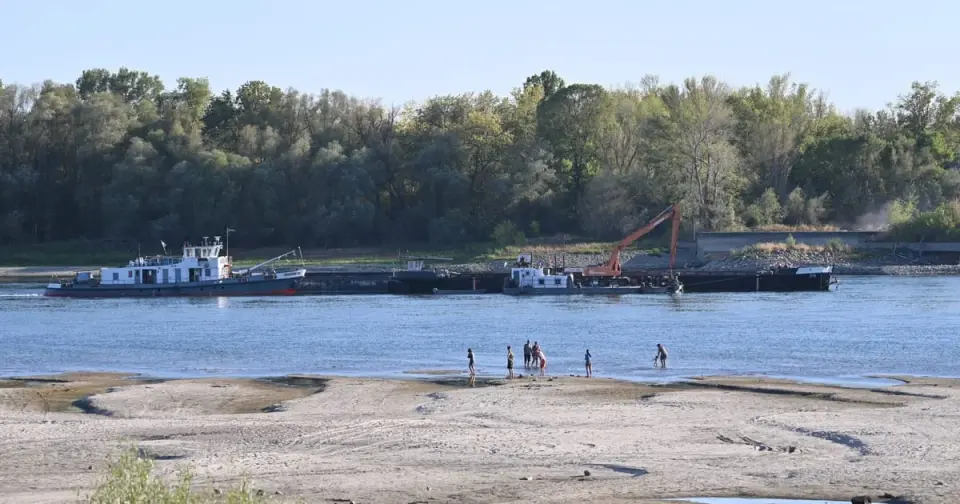
Hungary is sinking two barges and building a stone sill in the Danube River to raise water levels at the Paks nuclear plant, which supplies over a third of the country's electricity. Extreme heat and drought have caused record-low water levels, threatening reactor cooling. Prime Minister Péter Magyar announced the measures on August 15, 2026, after the water level dropped 122 cm below normal. The intervention aims to prevent a forced shutdown of one of the plant's two turbines, which was projected to occur if levels fell further. This follows earlier partial shutdowns and output reductions at Paks due to insufficient cooling water.
Key points
- Hungary is sinking two 80-meter barges loaded with rocks to raise Danube water levels near the Paks nuclear plant.
- A riverbed sill made of 150,000 cubic meters of stone is being constructed to slow current and boost water levels.
- The Danube's water level at Paks is 122 cm below normal and projected to drop further, risking a turbine shutdown.
- Paks provides over 33% of Hungary's electricity; a shutdown would cost up to 50 billion forints monthly.
- The intervention cost is estimated at around 6 billion forints, significantly less than the cost of a plant shutdown.
- Hungary's Defense Ministry has assigned 100 troops to work around the clock on the project.
Background
In early August 2026, the Paks nuclear plant faced severe cooling challenges due to record-low Danube water levels caused by extreme heat and drought. Output dropped to 240 MW overnight on August 2, 2026, from its usual 2,000 MW, prompting water-use restrictions. By August 5, levels stabilized, allowing the plant to remain online. Romania also faced similar issues, using a controlled blast to reroute water to its reactor. The current barge-sinking effort is a more permanent measure to ensure sustained cooling.
How outlets are covering it
Politico emphasizes the immediate action of sinking barges and the political implications for the Russian expansion deal. AP News focuses on the technical measures, including the sill construction and the risk of turbine shutdown. UNITED24 Media highlights the broader regional context, noting that France and Romania also faced nuclear disruptions due to heatwaves and droughts. All sources agree on the critical nature of the water level issue for Paks, but differ in emphasis: Politico on political consequences, AP on technical solutions, and UNITED24 on regional impacts.
Why it matters
The Paks plant is critical for Hungary's energy security, supplying over a third of its electricity. A shutdown would have severe economic and social consequences, including potential power rationing and increased energy costs. The measures taken by Hungary highlight the growing impact of climate change on energy infrastructure, particularly nuclear power, which relies on stable water levels for cooling. The situation also raises questions about the feasibility of expanding nuclear capacity in regions vulnerable to drought and heatwaves.
What to watch
Hungary will monitor the effectiveness of the barge-sinking and sill construction in raising water levels. If levels do not improve sufficiently, further measures may be required, including potential shutdowns. The government will also reassess the Russian-led expansion of Paks, which Magyar has cast doubt on due to water issues. Regional coordination among EU members may increase to address shared vulnerabilities to climate-driven energy disruptions.
- Hungary uses sunken barges to raise Danube River to keep nuclear plant going politico.eu
- Hungary to sink two barges near nuclear plant to raise Danube levels to ensure cooling Reuters
- Hungary Sinks Barges to Lift Danube Near Its Nuclear Plant Bloomberg.com
- Hungary’s government plans interventions on Danube River to keep nuclear plant running AP News
- “Two Concrete Pits”: Hungary’s New Government Reviews $11.5B Russian Nuclear Expansion UNITED24 Media
Want the full story? Read the original reporting
Read on politico.eu