
Mecca Defence Alliance formalizes structure in Istanbul amid US-Iran strikes
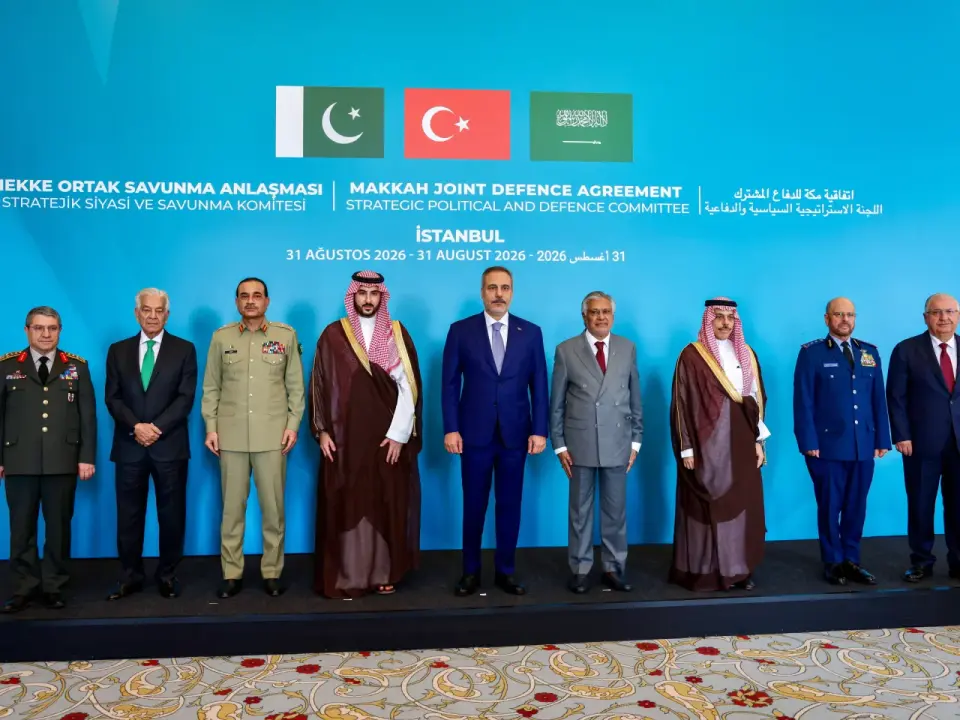
Pakistan, Saudi Arabia, and Turkiye have officially named their mutual defence pact the 'Mecca Defence Alliance' and established a secretariat in Riyadh, with the first secretary-general to be a Pakistani official. The inaugural meeting of the Strategic Political and Defence Committee in Istanbul focused on operationalizing the agreement, which was signed in August, through joint exercises and defence industrial cooperation. While the alliance is described as open to expansion and not targeted at any specific state, it emerges against the backdrop of renewed US-Iran hostilities, including recent strikes on Iranian targets in the Strait of Hormuz. Analysts remain divided on whether the pact represents a structural shift in regional security or a symbolic gesture, noting the lack of integrated command structures compared to NATO.
Key points
- The alliance was formally named the 'Mecca Defence Alliance' during a meeting in Istanbul on August 31, 2026, involving senior officials from Pakistan, Saudi Arabia, and Turkiye.
- A secretariat has been established in Riyadh, and the first secretary-general will be appointed from among Pakistani officials, according to Turkish Foreign Minister Hakan Fidan.
- The Strategic Political and Defence Committee, created under the August 7 agreement, began work on operational details, including military interoperability, joint exercises, and defence industrial cooperation.
- The pact includes a mutual defence clause stating that an attack on one member is an attack on all, but lacks the integrated command and standing forces of NATO, according to independent analysts.
- The meeting occurred shortly after the US military struck two Iranian rocket launchers on Larak Island, marking the first acknowledged US strike on Iran in a month, and Iran's subsequent retaliatory claims against bases in Jordan and the UAE.
- The alliance is described as open to expansion, with interest expressed by Bangladesh and potential interest from Egypt, though Egypt has cited constitutional and legal considerations regarding existing treaty commitments.
Background
The Mecca Joint Defence Agreement was signed on August 7, 2026, by Turkish President Recep Tayyip Erdogan, Saudi Crown Prince Mohammed bin Salman, and Pakistani Prime Minister Shehbaz Sharif. The pact was framed as a regional security initiative to reduce reliance on external security guarantees, particularly from the US, and to address vulnerabilities exposed by the ongoing US-Israel war on Iran, which began on February 28, 2026. Previous coverage indicated that the agreement was designed to promote burden-sharing and regional autonomy, potentially complicating US strategy in the Gulf. Bangladesh had also expressed interest in joining the pact, which some observers have dubbed an 'Islamic NATO,' though concerns about balancing relations with India and China remain.
How outlets are covering it
Al Jazeera and Al-Monitor emphasize the operationalization of the pact, highlighting the establishment of a secretariat in Riyadh and the focus on defence industrial cooperation and joint exercises. Daily Sabah and The Jerusalem Post focus on Turkish Foreign Minister Hakan Fidan's statements, particularly his assertion that the alliance is not directed at any specific country and his strong denunciation of Israeli Prime Minister Benjamin Netanyahu as an 'enemy of humanity.' Al Jazeera and Al-Monitor note that analysts are divided on the pact's significance, with some comparing it to NATO's Article 5 and others pointing to the lack of integrated command structures. Daily Sabah and The Jerusalem Post highlight the alliance's potential to reduce regional uncertainty, while Al Jazeera and Al-Monitor note the volatile context of renewed US-Iran strikes. Al-Monitor and Al Jazeera also note the potential for expansion, with Bangladesh and Egypt as candidates, though Egypt's accession is complicated by legal and treaty issues.
Why it matters
The formalization of the Mecca Defence Alliance signals a shift in regional security architecture, as major Muslim-majority states seek to create a collective security framework independent of US guarantees. The pact's operationalization, including a secretariat and joint defence mechanisms, could reduce reliance on external security umbrellas and influence US strategy in the Middle East. The alliance's potential expansion to other states, such as Egypt and Bangladesh, could further reshape regional alliances and deterrence dynamics. However, the lack of integrated command structures and the volatile context of the US-Iran war raise questions about the pact's immediate effectiveness and long-term viability.
What to watch
The next steps include the appointment of the first secretary-general of the Mecca Defence Alliance and the finalization of the institutional structure, including the roadmap for expansion. The alliance will likely continue to work on military interoperability, joint exercises, and defence industrial cooperation. The potential accession of Egypt and other Gulf states will depend on resolving legal and treaty issues, as well as achieving consensus among the founding members. The pact's effectiveness will be tested by the ongoing US-Iran conflict and the ability of the alliance to maintain cohesion and operational readiness in a volatile regional environment.
- Pakistan, Saudi Arabia, Turkiye meet: What’s next for their defence pact? Al Jazeera
- Saudi Arabia, Turkey and Pakistan agree to establish secretariat under joint defence pact Reuters
- Mecca Defence Alliance launched in Istanbul 'to reduce uncertainty' in region Daily Sabah
- Turkish FM Fidan denounces Benjamin Netanyahu, denies Mecca pact targets specific country The Jerusalem Post
- Saudi Arabia, Turkey, Pakistan set Mecca Alliance into motion Al-Monitor
Want the full story? Read the original reporting
Read on Al Jazeera