
Trump’s Xi Greeting Signals a Shift in US-China Power Dynamics
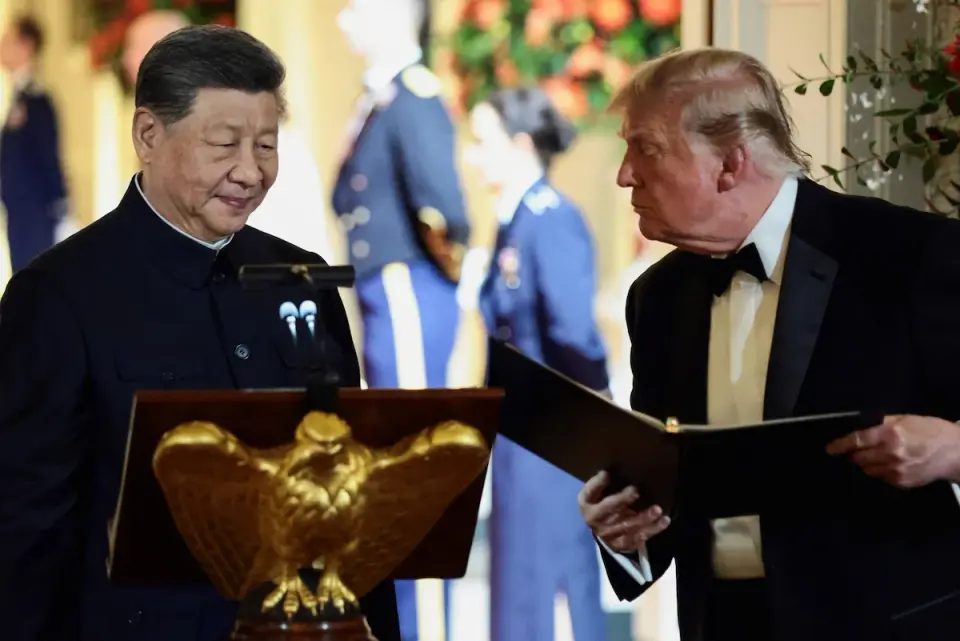
On September 23, 2026, President Donald Trump greeted Chinese President Xi Jinping at Joint Base Andrews, a gesture analysts interpret as a recognition of China as a peer rival. This event coincides with broader debates about the decline of US hegemony and the rise of a transactional global order where both Washington and Beijing prioritize narrow national interests over traditional leadership roles.
Key points
- Trump’s tarmac greeting of Xi Jinping on September 23, 2026, is viewed by strategists as a symbolic acknowledgment of China’s status as an equal power, moving beyond previous confrontational postures.
- Asia Times argues that the US is navigating stages of 'grief' regarding its loss of unipolar dominance, currently oscillating between bargaining and acceptance in its diplomatic approach to Beijing.
- The Philippine Star notes that both 'America First' and 'China First' policies reflect a retreat from global leadership responsibilities, with Beijing avoiding entanglement in crises like the Ukraine war and Strait of Hormuz blockade.
- Critics argue that this transactional approach by both superpowers risks creating a fragmented international system lacking a stabilizing leader, potentially leading to greater global instability.
- Patricia King of the Center for Asia Policy Studies highlights that China seeks 'global reach without entanglement,' prioritizing economic interests over the burdens of maintaining a rival international order.
Background
This development follows a period of intense US-China rivalry characterized by trade wars, export controls, and security alliances like AUKUS and the Quad. Previous coverage in our archive has focused on domestic US issues, such as the relocation of American Idol to Georgia due to tax incentives, which mirrors the broader theme of retrenchment and prioritization of domestic economic interests over global cultural or political leadership. The current diplomatic shift at Joint Base Andrews represents a potential pivot from this isolationist stance toward a more pragmatic, if still contentious, engagement with Beijing.
How outlets are covering it
Asia Times frames the situation through a psychological lens, suggesting the US is in the 'bargaining' stage of grief over its lost supremacy, with the Andrews greeting marking a tentative step toward 'acceptance' of a multipolar world. In contrast, The Philippine Star emphasizes the structural failure of both 'America First' and 'China First' doctrines, arguing that neither power is willing to assume the costs of global leadership. While Asia Times sees the tarmac greeting as a sign of mature acceptance, The Philippine Star views the current dynamic as a vacuum of leadership that perpetuates instability. Both outlets agree that the old unipolar order is over, but they differ on whether the current transactional approach is a healthy adaptation or a dangerous retreat from responsibility.
Why it matters
The shift from confrontation to pragmatic engagement, symbolized by the Trump-Xi meeting, could redefine the 21st-century global order. If the US and China fail to manage their rivalry constructively, the resulting vacuum of leadership may exacerbate conflicts in regions like the South China Sea and the Middle East. Conversely, a durable balance could facilitate cooperation on critical issues like climate change and AI safety, though current policies suggest a continued focus on narrow national interests at the expense of global stability.
What to watch
Analysts will watch for concrete policy shifts following the September 23 meeting, particularly in trade negotiations and semiconductor supply chains. The US may continue to oscillate between 'bargaining' and 'anger' in its domestic politics, while China will likely maintain its strategy of 'global reach without entanglement.' The long-term outcome depends on whether both nations can move from transactional interactions to a stable, rules-based balance, or if the lack of global leadership leads to further fragmentation and conflict.
Want the full story? Read the original reporting
Read on Asia Times