
Mecca Pact Combines 1.4 Million Troops but Faces Skepticism Over Operational Reality
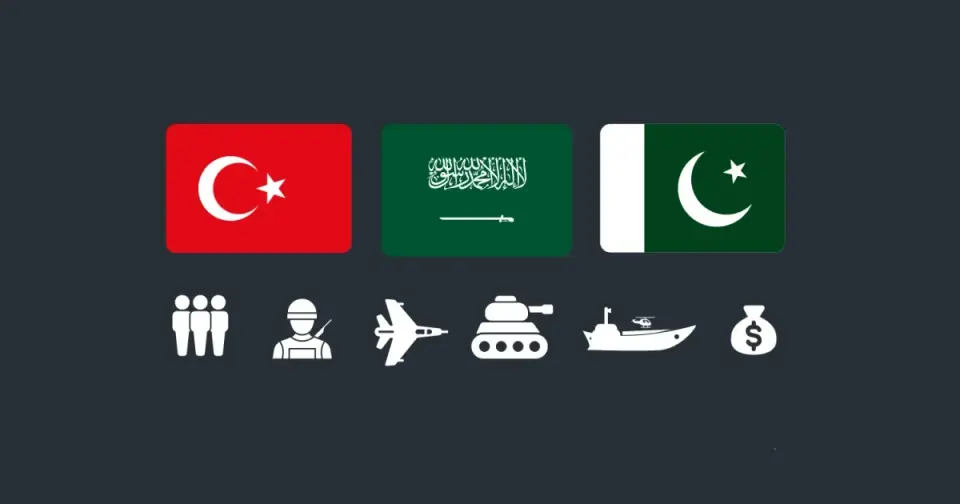
Saudi Arabia, Turkiye, and Pakistan signed the Mecca Joint Defence Agreement on August 7, 2026, pledging that an attack on one is an attack on all. The pact combines nearly 1.4 million active personnel, 3,400 aircraft, and $124.4 billion in annual defense spending. While it aims to diversify security partnerships away from the US, analysts debate whether the alliance is a practical military bloc or symbolic signaling.
Key points
- The agreement was signed by Saudi Crown Prince Mohammed bin Salman, Turkish President Recep Tayyip Erdogan, and Pakistani Prime Minister Shehbaz Sharif in Mecca.
- Combined military strength includes 1.4 million active personnel, 3,415 aircraft, 6,046 tanks, and 344 naval assets.
- Saudi Arabia contributes the largest budget at $63.9 billion, followed by Turkiye at $51.4 billion and Pakistan at $9.1 billion.
- Turkiye’s Foreign Minister Hakan Fidan described the pact as technically similar to NATO’s Article 5, requiring a member request for joint action.
- Egypt was cited as a potential future member, though analysts note Cairo may hesitate due to existing ties with Washington.
Background
This pact follows a 2025 Saudi-Pakistan Strategic Mutual Defense Agreement and a failed 2026 quadrilateral discussion that included Egypt. Previous archive coverage noted the pact aims to deepen interoperability and create a regional security umbrella without naming specific adversaries, while Iran dismissed the move as speculative.
How outlets are covering it
Al Jazeera emphasizes the complementary nature of the bloc, highlighting Saudi capital, Turkish industrial capacity, and Pakistani manpower and nuclear status. The Christian Science Monitor frames the pact as a response to the Iran war and perceived Israeli hegemony, noting it signals a shift away from exclusive US reliance. JINSA argues the pact is largely symbolic theater, pointing to historical failures of Middle Eastern collective defense agreements and noting that the signatories face different primary adversaries, making genuine collective action unlikely. JINSA also highlights that the pact lacks integrated command structures, unlike NATO.
Why it matters
The pact represents a significant shift in regional security architecture, potentially reducing dependence on US guarantees. It introduces a new dynamic where major Muslim powers coordinate defense, which could influence US-Iran relations and the stability of the Gulf. However, its effectiveness remains unproven due to divergent national interests and the absence of a unified command structure.
What to watch
Observers will watch for Egypt’s potential accession and the operationalization of the pact. The next critical test will be how the alliance responds to future proxy attacks on Saudi infrastructure, particularly from Yemen or Iraq, to determine if it moves beyond symbolic statements to tangible military support.
- What are Saudi Arabia, Turkiye and Pakistan’s joint military capabilities? Al Jazeera
- The Regional Order Iran Wanted Is Taking Shape Without It Foreign Policy
- With Middle East still at war, three regional powers ink a new alliance The Christian Science Monitor
- Third Time Is the Charm? The Mecca Pact and the Sad History of Collective Defense JINSA
- Iran says no reason to fear Pakistan-Turkey-Saudi security pact Reuters
Want the full story? Read the original reporting
Read on Al Jazeera