
Berlin and Paris propose 'second-strike' tool to cut off EU market access
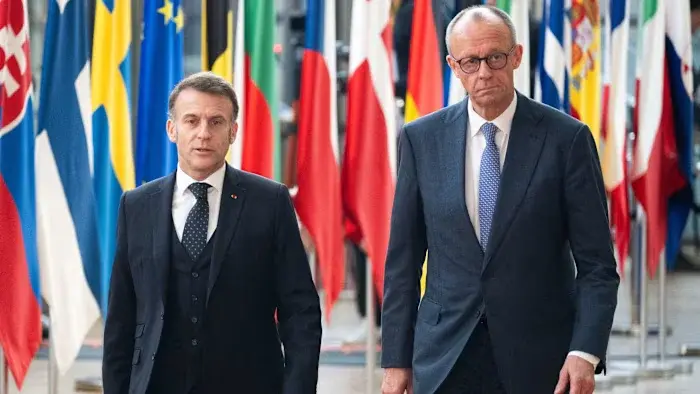
German Chancellor Friedrich Merz and French President Emmanuel Macron have jointly proposed a new EU trade instrument that could immediately cut off access to the single market in response to economic coercion. The move marks a significant shift for Berlin toward protectionism, aiming to counter Chinese restrictions on critical supplies like rare earths and magnets. The proposal seeks to bypass standard qualified majority voting rules, allowing a minority of member states to trigger the measure. This initiative is designed to prepare for upcoming EU Council meetings and address the bloc's growing trade deficit with China, which now exceeds its deficit with the United States.
Key points
- Merz and Macron sent a letter to Commission President Ursula von der Leyen urging the expansion of the EU's trade toolbox to counter 'weaponisation of trade'.
- The proposed instrument would allow for an immediate cut-off from the internal market if vital supplies are restricted, described by a German official as a 'second-strike weapon'.
- The measure is designed to be 'country agnostic' but is widely interpreted as a response to Beijing's recent export restrictions on rare earths and magnets, which caused production halts in European automotive plants.
- The proposal suggests triggering the instrument via a minority vote, reversing the usual qualified majority requirement, to ensure rapid action.
- A complementary 'diversification instrument' is also proposed to reduce reliance on single-source imports for critical materials.
- The shift reflects Merz's move away from traditional free-trade orthodoxy, influenced by the impact of Chinese EVs and US tariffs on German industry.
Background
This development follows a series of escalating trade tensions in late 2026. In September, Beijing warned of retaliation if the EU introduced Section 301-style barriers, coinciding with EU Trade Commissioner Maros Sefcovic's talks in Beijing to address a record trade deficit. Additionally, China launched an anti-dumping probe into European chemical exports in early October, just days before these high-level negotiations. The current proposal builds on earlier internal EU debates, such as the September clash over the definition of 'Made in Europe' within the Industrial Accelerator Act, where France and Germany held differing views on the scope of industrial protection.
How outlets are covering it
The Financial Times frames the proposal as a historic pivot for Germany, highlighting Merz's abandonment of free-trade principles in favor of 'strategic autonomy' alongside Macron. It notes skepticism from some EU diplomats who argue the bloc lacks the will to use existing tools, questioning the deterrent value of new instruments. The secondary source from Yahoo, while largely obscured by technical code, confirms the core narrative of Merz and Macron pushing for measures against unfair trade practices, aligning with the FT's report on the joint Franco-German initiative. The FT emphasizes the specific mechanism of minority voting and the 'second-strike' analogy, whereas the broader context suggests this is part of a wider, multi-front strategy involving anti-dumping probes and industrial policy debates.
Why it matters
This proposal signals a fundamental change in EU trade policy, moving from passive defense to active deterrence. By proposing a tool that can bypass standard voting rules, the EU aims to create a credible threat against economic coercion, particularly from China. The success of this instrument will determine whether the EU can effectively protect its industrial base from supply chain disruptions and unfair competition, potentially reshaping global trade dynamics and setting a precedent for how the bloc responds to future geopolitical pressures.
What to watch
The proposal is intended to shape consensus ahead of an EU Council meeting next week, where the Commission will update leaders on its ongoing talks with China. The next steps involve negotiating the legal framework for the new instrument and the 'diversification instrument' within the EU. The outcome will depend on whether other member states support the shift from qualified majority to minority voting for such drastic measures, and whether the EU can demonstrate the political will to deploy these tools if triggered.
- Germany and France agree on last-resort tool against trade threats Financial Times
- Germany and France Push Trade Weapon to Bar China Access Bloomberg.com
- Germany and France Are Proposing a New Weapon to Counter Flood of Chinese Goods WSJ
- Merz, Macron push for EU measures against unfair trade practices Yahoo
- EU, China to hold Beijing talks to avert trade war CNA
Want the full story? Read the original reporting
Read on Financial Times