
Jaishankar Rebuts Terrorism Allegations at UN Amid Cybercrime Treaty Signing
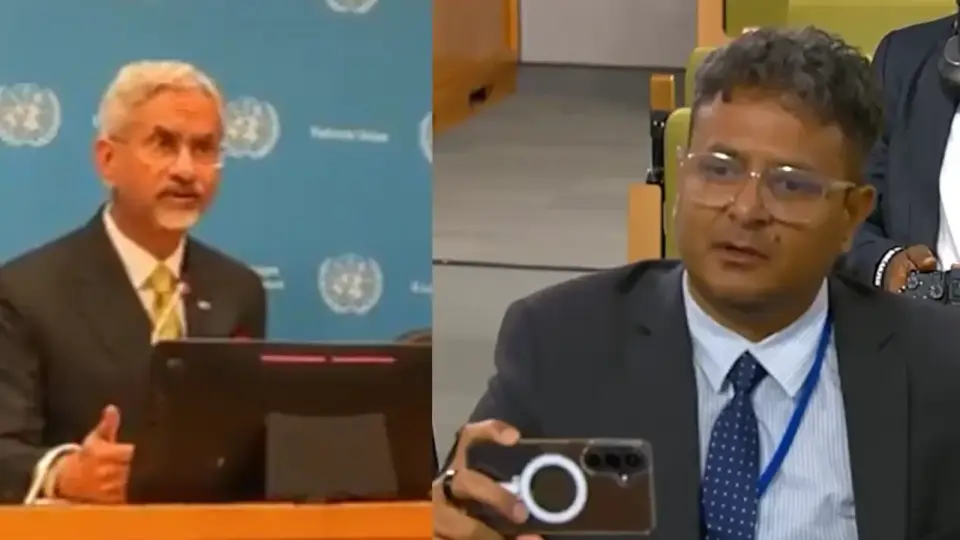
India’s External Affairs Minister S. Jaishankar sharply rejected a Pakistani journalist’s claim that New Delhi sponsors terrorism during a press briefing at the 81st UN General Assembly. The incident occurred alongside the launch of a maritime safety initiative with Liberia and followed India’s recent missile strikes on terror targets in Pakistan. In a separate development, India signed the UN Convention against Cybercrime, though the treaty has not yet entered into force.
Key points
- Jaishankar responded to a heckling question by stating, 'A terrorist country is asking me that question,' before exiting the room with other delegates.
- The exchange took place during a briefing on the Group of Friends on Safety and Security of Shipping and Seafarers, which India launched with Liberia.
- India cited the April 2025 Pahalgam attack, which killed 26 people, as justification for its subsequent missile strikes on nine terror-linked sites in Pakistan and Pakistan-occupied Kashmir.
- Indian diplomat Kshitij Tyagi accused Pakistan of failing to address civilian deaths and supply shortages in Pakistan-occupied Kashmir during a UN Human Rights Council session.
- India signed the UN Convention against Cybercrime on Friday, but the treaty requires 40 ratifications to enter into force, with only three parties currently listed.
Background
This diplomatic friction follows India’s 'Operation Sindoor,' a series of missile strikes targeting infrastructure linked to Lashkar-e-Taiba and Jaish-e-Mohammad. These actions were taken in response to the April 22, 2025, attack in Pahalgam, Jammu and Kashmir, which resulted in 26 fatalities. The current UN General Assembly session highlights ongoing tensions regarding cross-border terrorism and maritime security.
How outlets are covering it
NDTV and The Times of India emphasize the heated nature of the exchange, noting that Jaishankar and other delegates exited the room while the journalist continued speaking. Hindustan Times highlights that the event was originally designated as a 'remarks-only' briefing, underscoring the disruption caused by the interruption. Diya TV provides a more neutral framing, noting that the exchange did not establish evidence for the claim against India and contextualizing the event within the broader maritime safety initiative. All sources agree on the factual occurrence of the rebuttal and the subsequent signing of the cybercrime treaty.
Why it matters
The incident underscores the deepening diplomatic rift between India and Pakistan at the global stage, particularly regarding counter-terrorism operations and international perceptions of state-sponsored violence. Simultaneously, India’s engagement with the UN Convention against Cybercrime signals a strategic pivot toward digital governance and international legal cooperation, despite ongoing geopolitical tensions.
What to watch
Jaishankar is scheduled to address the High-Level Session of the UN General Assembly on Saturday. The UN Convention against Cybercrime will not enter into force until 90 days after the 40th country ratifies it; currently, only three parties have done so. India’s position on cross-border terrorism remains a central issue in its bilateral and multilateral engagements.
- "Terrorist Country Asking Me?" S Jaishankar Rips Into Pak Journalist's Question NDTV
- 'A terrorist country is asking me': Jaishankar's sharp reply to Pak journalist The Times of India
- ‘Terrorist country asking me’: Jaishankar fires back at Pakistani reporter's attempts to heckle at UNGA Hindustan Times
- India’s Jaishankar rebuts Pakistan allegation at UN as India signs cybercrime treaty Diya TV
- A terrorist country is asking me that: Jaishankar as Pak reporter accuses India of sponsoring terror | A video of the interaction has surfaced | Inshorts Inshorts
Want the full story? Read the original reporting
Read on NDTV