
Sikorski Warns Moscow at UN: NATO’s Economic and Military Weight Makes Victory Impossible
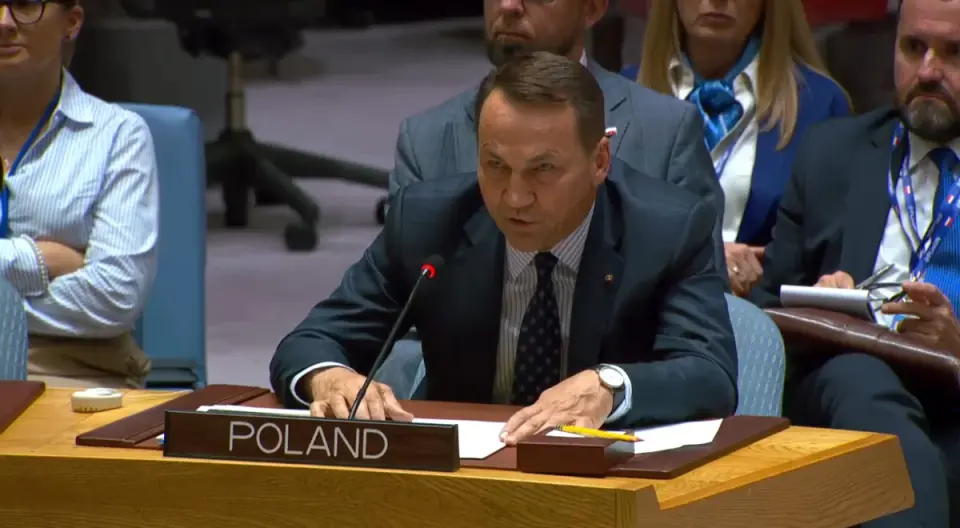
Polish Foreign Minister Radosław Sikorski delivered a sharp rebuke to Russian Foreign Minister Sergey Lavrov at the UN Security Council, rejecting Kremlin narratives about the 2014 Maidan events and the status of the Russian language in Ukraine. Sikorski argued that Moscow’s escalating aggression signals panic rather than strength, noting that Russia has failed to conquer Ukraine despite four years of war. He emphasized that NATO’s combined GDP is 25 times larger than Russia’s, making a Russian victory unattainable. Sikorski also warned of spreading hybrid threats, including drone strikes near NATO borders and cyberattacks, urging Lavrov to tell President Putin to stop the war.
Key points
- Sikorski rejected Lavrov’s characterization of the 2014 Ukrainian revolution as a 'bloody coup,' stating that President Yanukovych was voted out by a democratically elected parliament after a massacre of over 100 civilians.
- The Polish minister dismissed claims that the Russian language is banned in Ukraine, citing his recent visit to Kyiv where Russian is widely spoken.
- Sikorski described Russia’s recent escalation as a sign of panic, noting that Putin has achieved nothing after four years of war and is running out of troops and resources.
- He highlighted the economic disparity, stating that Poland’s GDP is nearly half of Russia’s, Europe’s is 10 times larger, and NATO’s is 25 times larger.
- Sikorski warned of expanding Russian threats, including drone strikes near Polish, Moldovan, and Romanian borders, airspace violations in Baltic and Nordic states, and a US indictment of a Russian intelligence network for conspiracy to commit murder in the US.
- In a separate interview, Sikorski stated that Poland has stockpiled supplies and prepared shelters in response to hybrid threats, drawing parallels to the pre-invasion rhetoric of 2022.
Background
This confrontation occurs during the UN General Assembly high-level week, where Ukrainian President Volodymyr Zelensky also addressed the assembly, urging continued pressure on Russian revenues. Recent archive coverage highlights the intense diplomatic activity at the UN, including disputes over media access and the ongoing search for a new UN Secretary-General, reflecting a broader atmosphere of geopolitical tension and institutional scrutiny.
How outlets are covering it
While Kyiv Post focuses on Sikorski’s rhetorical dismantling of Lavrov’s claims and his economic arguments against Russian victory, Hromadske highlights the defensive preparations in Poland, noting Sikorski’s personal stockpiling and warnings about hybrid threats like cyberattacks on hospitals and financial systems. UATV emphasizes the military dimension, reporting that Sikorski warned Russia that NATO possesses superior combat aviation and could respond offensively to any attack, citing Ukrainian strikes on Russian oil refining as a model for potential NATO action. The outlets differ in emphasis: Kyiv Post centers on the diplomatic confrontation and economic reality, Hromadske on civil preparedness and hybrid warfare, and UATV on military deterrence and air superiority.
Why it matters
Sikorski’s remarks signal a shift in Western rhetoric from mere support for Ukraine to explicit warnings about the consequences of further Russian aggression. By framing the conflict as a matter of economic and military inevitability, Poland is attempting to deter Moscow from expanding the war into NATO territory. The emphasis on hybrid threats and civil preparedness indicates that European nations are increasingly viewing the conflict as a direct security risk, not just a regional issue. This hardening stance may influence future NATO defense planning and sanctions enforcement.
What to watch
Watch for further diplomatic exchanges at the UN General Assembly, particularly any responses from Russian officials to Sikorski’s warnings. Monitor for any escalation in hybrid threats, such as cyberattacks or drone incidents near NATO borders. Observe whether Poland’s announced military aid package for Ukraine is finalized and how it aligns with broader NATO support. Look for signs of increased civil preparedness measures in Poland and other Eastern European states as hybrid threats continue.
- ‘Tell Your Boss: Enough Is Enough,’ Polish FM Confronts Lavrov at UN Kyiv Post
- Poland’s foreign minister stocks rice and homemade jam as country prepares for potential crises Hromadske
- El Niño transforms Chile's Atacama Desert as thousands of hectares bloom Inbox.eu
- Poland’s Foreign Minister To Russians: “Be Careful, We Have More Combat Aircraft Than You Do” uatv.ua
- Poland’s Sikorski Accuses Russia of Escalating War as Kremlin Panic Grows at UN Межа. Новини України.
Want the full story? Read the original reporting
Read on Kyiv Post