
Turkish Grain Carrier Sinks in Black Sea After Russian Drone Strike
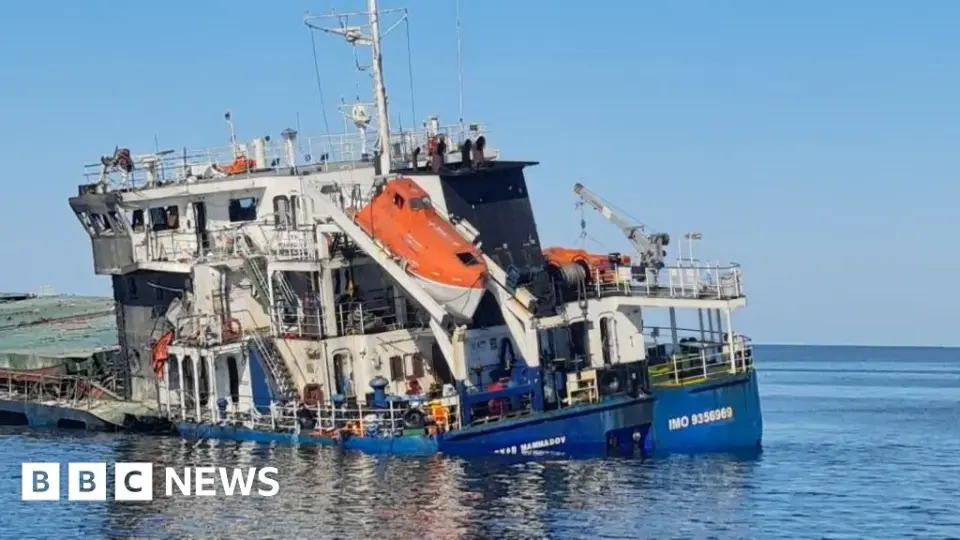
A Turkish-owned cargo ship carrying corn sank in the Black Sea on Monday after being struck by drones, killing two crew members and leaving one missing. President Volodymyr Zelensky condemned the attack as a 'horrific' strike on a civilian vessel in neutral waters, while Romanian authorities confirmed a rescue operation that saved 11 sailors. The incident occurs amid escalating Russian strikes on Ukrainian infrastructure and growing tensions over maritime security in the region.
Key points
- The vessel, identified as the Royad Mammadov, was owned by Turkish company MG Shipping 5 and was carrying corn when it caught fire and sank.
- Two crew members, including the captain, were killed, and one remains missing; 11 others were rescued by Romanian authorities, with three reported injured.
- Zelensky stated the ship was in neutral waters and blamed Russia for the attack, calling for international pressure to restore global food security.
- Romania’s interior ministry confirmed the incident occurred within its exclusive economic zone, approximately 30 nautical miles south of the port of Sfantu Gheorghe.
- Russia has not officially commented on the specific incident but has recently intensified strikes across Ukraine in retaliation for Ukrainian attacks on Russian oil refineries.
Background
This incident follows a pattern of escalating maritime tensions in the Black Sea. In late August and September 2026, Russian forces conducted sustained drone barrages against Ukrainian infrastructure and civilian shipping, including a previous strike on a cargo ship that killed its captain. These events have coincided with rising global grain prices due to export disruptions and U.S. corn shortages. Additionally, Ukraine has been conducting drone strikes on Russian oil infrastructure and shadow-fleet vessels, which Moscow cites as justification for its retaliatory actions.
How outlets are covering it
BBC and Euronews agree on the core facts: the sinking of the Turkish-owned Royad Mammadov, the death of two crew members, and the rescue of 11 others. Euronews provides additional detail on the ship’s ownership (MG Shipping 5) and its route from Ismail, Ukraine, to Ravenna, Italy. Ukrainian Pravda emphasizes Zelensky’s statement that the vessel was in neutral waters and highlights the nationalities of the crew (Azerbaijani and Indian). All sources note the lack of official Russian comment on this specific strike, though BBC and Euronews contextualize it within Russia’s broader campaign of strikes against Ukrainian infrastructure and oil refineries. Euronews also notes recent drone incursions into Romanian airspace, framing the event as part of a broader pattern of hybrid warfare and maritime instability along Europe’s eastern flank.
Why it matters
The sinking of a civilian grain carrier in neutral waters threatens to further destabilize global food supply chains, particularly for corn and wheat, which are already under price pressure. It underscores the risks of maritime navigation in the Black Sea and may intensify diplomatic efforts by Turkey and the UN to secure a ceasefire or safe passage for grain shipments. The incident also highlights the escalating nature of the conflict, with Russia targeting civilian infrastructure and shipping in retaliation for Ukrainian strikes on its energy sector.
What to watch
Romanian authorities are continuing the search for the missing crew member. International diplomatic efforts, including talks between Turkey, the UN, Russia, and Ukraine, may accelerate to address Black Sea security and grain export routes. Russia may continue its campaign of strikes on Ukrainian infrastructure and maritime targets, while Ukraine may further escalate its attacks on Russian oil refineries and shadow-fleet vessels. Western allies, particularly in NATO, may increase vigilance against hybrid warfare incidents and drone incursions in the region.
- Zelensky condemns 'horrific' Russian strike on boat carrying corn in Black Sea bbc.com
- Turkish grain ship sinks in Black Sea after deadly drone attack Euronews.com
- Ukraine says Russian drones behind Turkish ship sinking dw.com
- Romania says two dead after fire on ship, Ukraine blames Russian drones Reuters
- Russian drones attack Turkish vessel, captain killed – Zelenskyy Українська правда
Want the full story? Read the original reporting
Read on bbc.com