
Mecca Pact Formalizes Sunni Bloc, Challenging US Hegemony and Israel
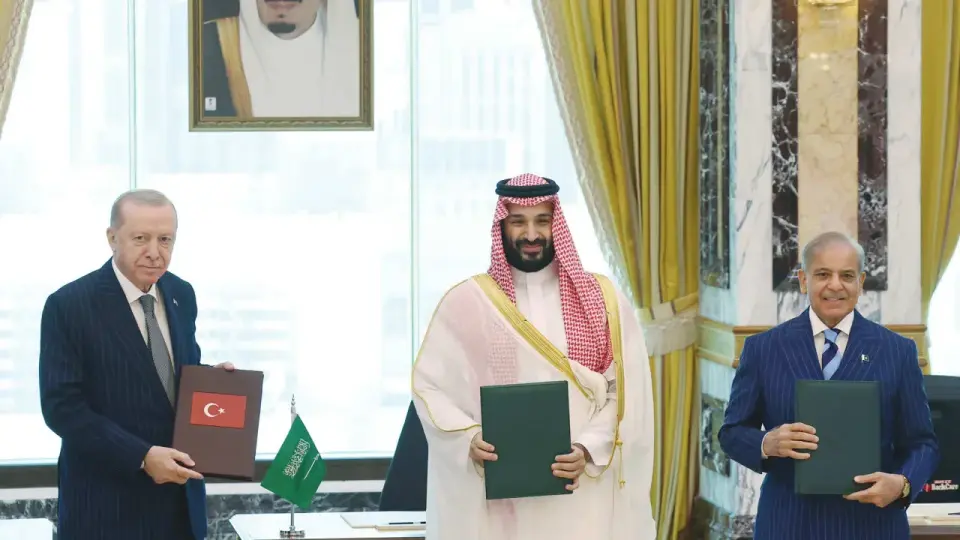
On August 7, 2026, Saudi Arabia, Turkey, and Pakistan signed the Mecca Joint Defense Agreement, establishing a mutual defense pact that mirrors NATO’s Article 5. This move signals a shift away from US-led regional security toward a conservative Sunni bloc, complicating Israel’s strategic position and challenging Washington’s influence in the Middle East.
Key points
- The Mecca Joint Defense Agreement, signed on August 7, 2026, by Saudi Arabia, Turkey, and Pakistan, stipulates that an armed attack against any one signatory is considered an attack against all, echoing NATO’s Article 5.
- The pact is part of a broader emerging Sunni Islamic bloc that includes Qatar and the new Syrian regime under Ahmed al-Sharaa, with Turkey and Pakistan as core military partners.
- The agreement was tested 48 hours after signing when Houthi forces attacked a Saudi Aramco refinery in Jazan, but no military response from Turkey or Pakistan followed, highlighting the pact’s limited immediate operational impact.
- Saudi Arabia’s participation is seen as a hedge against perceived US unreliability, particularly after Washington’s failure to defend Gulf interests against Iranian attacks and its withdrawal from major regional commitments.
- The bloc’s anti-Israel rhetoric, including calls for a 'united military front' by Pakistan’s defense minister and Erdogan’s warnings against 'Zionism,' is viewed as a strategic element, not just rhetoric, potentially influencing future conflicts in Syria and the Eastern Mediterranean.
Background
The Mecca pact follows a series of shifts in Middle East security, including the 2020 Abraham Accords, which sought to normalize relations between Israel and Gulf states, and the 2026 Trump-Saudi nuclear deal, which dropped the condition of Israel normalization. Earlier coverage noted that the pact could complicate Arab-Israeli normalization and test US strategy by promoting regional autonomy. The agreement also comes amid ongoing Houthi attacks on Saudi targets and a broader US retrenchment from the region, as highlighted in prior analyses of US unpredictability and the erosion of its regional order.
How outlets are covering it
The Jerusalem Post emphasizes the pact’s symbolic and strategic significance for Israel, arguing that the anti-Israel rhetoric of the emerging Sunni bloc is integral to its strategy, not just rhetoric. It highlights the role of Jerusalem as a unifying symbol for the bloc and warns of potential military implications. The Council on Foreign Relations (CFR) frames the pact as evidence of the end of the US-led Middle East order, focusing on how regional powers are now shaping their own security architecture. CFR notes that the pact’s importance lies not in its immediate military guarantees but in its challenge to US primacy and the potential for a two-bloc Middle East: the Abraham Accords allies versus the Mecca Agreement bloc. Both sources agree on the pact’s significance but differ in emphasis: JPost focuses on the threat to Israel, while CFR highlights the broader geopolitical shift away from US influence.
Why it matters
The Mecca Joint Defense Agreement marks a pivotal moment in Middle East security, signaling a move away from US-led regional order toward a more autonomous, Sunni-led bloc. This shift could complicate Israel’s security calculus, challenge the Abraham Accords, and reduce US influence in the Gulf. The pact’s long-term implications depend on how the bloc evolves, particularly in relation to Iran, the Houthis, and potential conflicts in Syria and the Eastern Mediterranean.
What to watch
Analysts expect the Mecca bloc to continue consolidating, with potential expansion to include Qatar and Syria. The next steps will likely involve further diplomatic and military cooperation among the signatories, as well as a test of the pact’s resilience in the face of regional conflicts. The US may need to reassess its strategy in the Middle East, potentially seeking to re-engage with Gulf states or adjust its approach to Iran and Israel. The bloc’s anti-Israel stance could also influence future conflicts, particularly in Syria and the Eastern Mediterranean, where Turkey and Qatar are key players.
- The new crescent: Mecca pact gives rise to a Saudi-led Sunni bloc, posing new challenges for Israel The Jerusalem Post
- Erdogan says Egypt could join Turkiye-Saudi-Pakistan defence pact Al Jazeera
- The U.S.-Led Middle East Order Is Over. The Mecca Agreement Proves It. Council on Foreign Relations
- The Gulf's New NATO? Chicago Council on Global Affairs
- Turkey lays out plans for defence pact with Pakistan and Saudi Arabia Reuters
Want the full story? Read the original reporting
Read on The Jerusalem Post