
Ukraine’s Magura Naval Drones Pivot to Land Strikes, Targeting Russian Air Defenses
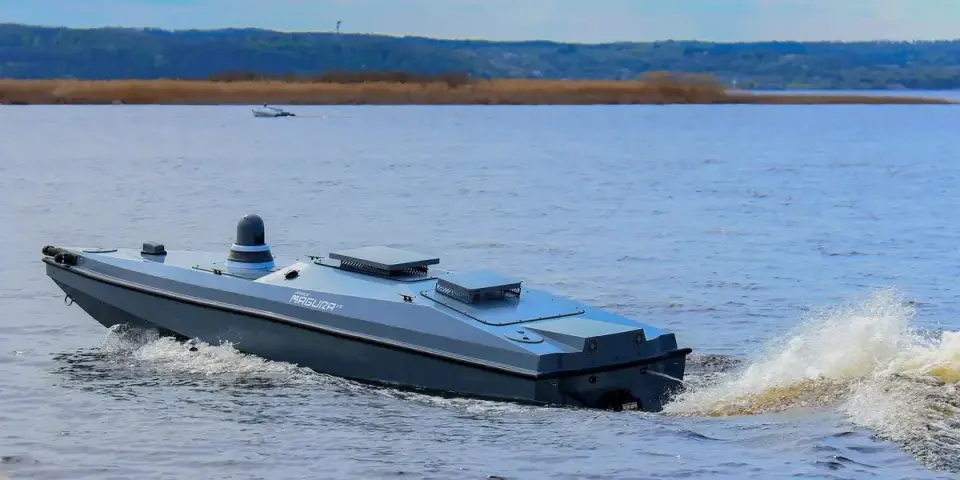
Ukraine’s Magura naval drones, originally designed to sink Russian warships, are now being used to launch FPV drones and strike land-based targets. The GUR confirmed these platforms destroyed Russian Pantsir-S1 and S-400 air defense systems in August. UFORCE, the manufacturer, recently raised $700 million to scale production, valuing the company at $6 billion.
Key points
- The GUR revealed in August that Magura drones serve as carriers for FPV drones, striking land targets using 'Podlyot' radar and 'Parol-4' IFF interrogators.
- In August, drones launched from Maguras destroyed a Pantsir-S1 system, two S-400 launchers, and an Orion drone control antenna.
- UFORCE CEO Oleg Rogynskyy stated that Russian air defenses are ill-equipped to handle low-flying heavy drones at night.
- UFORCE raised $700 million in a Series A round, reaching a $6 billion valuation, with investors including the UK government and Silicon Valley firms.
- Zelenskyy highlighted in March that naval drones now shoot down fighter jets and strike land targets, marking a shift from simple kamikaze sea drones.
Background
Ukraine’s naval drone capabilities have evolved significantly since the invasion began. Earlier reports indicated that Magura drones were used to shoot down helicopters and fighter jets in 2024 and 2025. The GUR confirmed in October that the Magura was improved into a multifunctional platform capable of carrying missile weapons and aerial drones. This development follows Ukraine’s broader strategy of using unmanned assets to offset conventional naval disadvantages, as seen in recent Baltic Sea strikes on Russian vessels.
How outlets are covering it
Business Insider emphasizes the tactical shift of naval drones to land operations, highlighting specific August strikes on air defense systems and UFORCE’s funding round. EUobserver focuses on the broader battlefield context, noting Russia’s attempts to weaponize the Dnipro River and the strategic implications of Ukraine’s evolving drone capabilities. While BI details the technical and financial aspects of UFORCE’s expansion, EUobserver frames the conflict within the larger geopolitical and military strategy of the war.
Why it matters
The adaptation of naval drones for land strikes demonstrates Ukraine’s ability to innovate and leverage technology to counter Russian air defenses. This shift could alter the balance of power on the ground, as Russian air defense systems are not designed to counter low-flying, autonomous drones. UFORCE’s funding round signals international confidence in Ukraine’s defense innovation, potentially influencing future naval and land warfare strategies globally.
What to watch
UFORCE plans to scale manufacturing in Ukraine and partner countries, aiming for fully unmanned navies and autonomous patrol presence. Rogynskyy predicts that most navies will adopt AI-controlled, unmanned assets. Ukraine may see more creative uses of Magura drones, including amphibious ground drone deployments and supply deliveries, as training exercises continue to refine these capabilities.
- Ukraine's naval drones made their name attacking Russian warships. Now they're taking the fight onto land. Business Insider
- With Russia’s front collapsing, Putin is weaponising the Dnipro River by using it to slice Ukraine in two (Ukraine Battlefield update, Day 1,722) EUobserver
- To defend against Russian drones, Ukraine uses less ammo, more AI The Christian Science Monitor
- Serhii Sternenko: There are far bigger threats ahead of us than jet-powered Shahed drones Українська правда
- From Reconnaissance Drones to Jet-Powered UAVs: How Dronefall Is Advancing Drone-Based Air Defense Повернись живим
Want the full story? Read the original reporting
Read on Business Insider