
Putin Signs Sweeping Law Freezing Assets and Blocking Services for Exiled Russians Convicted in Absentia
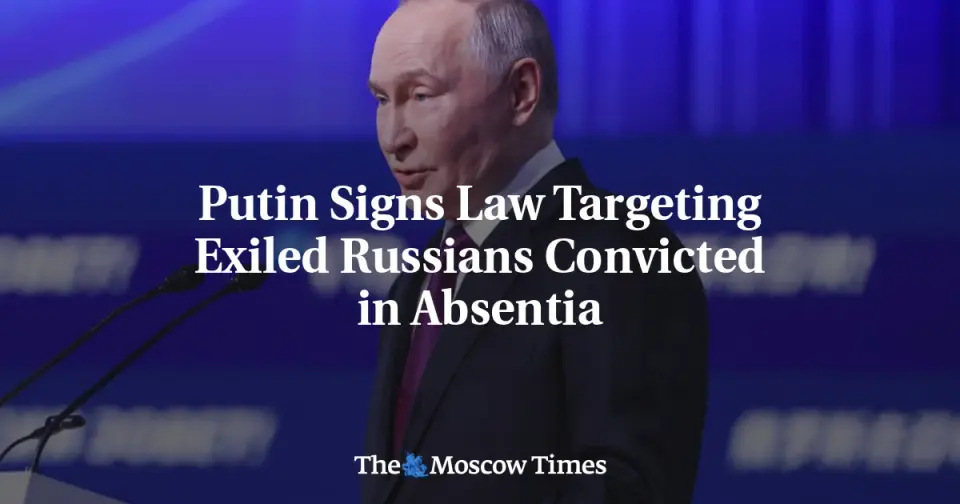
Vladimir Putin has signed a new law imposing severe financial and administrative restrictions on Russian citizens living abroad who have been convicted in absentia. The measure creates a centralized blacklist managed by the Justice Ministry, freezing assets and blocking access to banking, consular services, and state benefits for those deemed to be evading punishment. This action targets individuals prosecuted under 'foreign agent' and 'undesirable organization' laws, effectively stripping them of citizenship rights while abroad. Simultaneously, Putin signed legislation regulating cryptocurrency trading under strict Central Bank oversight and tightening immigration rules for foreigners with criminal records.
Key points
- Putin signed a law creating a register of Russians abroad convicted in absentia, including for 'foreign agent' violations and 'discrediting' the military.
- Listed individuals face frozen assets, blocked property transactions, and a ban on remote banking and online state services.
- Russian embassies are prohibited from issuing new passports to blacklisted individuals, allowing only certificates of life.
- The Justice Ministry maintains the list, with the Prosecutor General having authority to add names; data is shared with the FSB, tax services, and Central Bank.
- Separate legislation legalizes cryptocurrency trading under Central Bank oversight, limiting non-qualified investors to 300,000 rubles annually.
- New immigration laws deny citizenship and residency to foreigners with unexpunged criminal records, regardless of the crime's severity.
Background
This development follows a broader trend of tightening controls on Russian citizens and foreigners. In August 2026, anti-war figure Boris Nadezhdin fled to Paris after being designated a 'foreign agent,' illustrating the pressure on opposition figures. Earlier in June 2026, legislation was passed allowing the seizure of domestic property from citizens abroad accused of acting against the constitutional order, effective September 1. The current law expands these measures by targeting the financial and administrative existence of exiles, complementing previous restrictions on 'undesirable organizations' and 'foreign agent' status.
How outlets are covering it
The Moscow Times and UNITED24 Media focus on the domestic impact on exiled critics, describing the law as an 'effective deprivation of citizenship' that strips individuals of banking and consular rights. They highlight the use of 'foreign agent' and 'undesirable organization' laws against anti-war activists. In contrast, 1News.az and operativmm.az emphasize the external dimension, detailing how the same signing session introduced strict barriers for foreigners seeking Russian citizenship or residency. These outlets note that the new rules deny documents to anyone with a criminal record, regardless of severity, and expand administrative expulsion grounds from 22 to 45 offenses. While the primary sources view the law as a tool of internal repression against exiles, the secondary sources frame it as part of a broader tightening of migration and security controls.
Why it matters
The new law significantly escalates the state's ability to control Russian citizens abroad, effectively neutralizing the legal and financial existence of those convicted in absentia. By freezing assets and blocking consular services, the Kremlin aims to punish political opponents and critics without requiring physical detention. The concurrent regulation of cryptocurrency and immigration signals a broader strategy to tighten state control over financial flows and population movement, reducing the autonomy of both exiles and foreign nationals within the Russian legal system.
What to watch
The Justice Ministry will begin populating the official register of individuals evading punishment abroad. The prosecutor general and deputy will have authority to add names to this list. Cryptocurrency exchanges and digital depositories have until July 1, 2027, to obtain the required licenses under the new Central Bank oversight regime. The food supply chain data access law will take effect on January 1, 2027, allowing agencies to monitor prices and transactions for staple goods.
- Putin Signs Law Targeting Exiled Russians Convicted in Absentia The Moscow Times
- Putin Signs Law Stripping Russians Abroad of Banking, Passport, and Property Rights UNITED24 Media
- Putin signs law imposing sweeping restrictions on Russians convicted in absentia The Kyiv Independent
- Migrants with criminal records will no longer be able to obtain Russian citizenship 1News.az
- Russia tightens citizenship and residency rules for foreigners operativmm.az
Want the full story? Read the original reporting
Read on The Moscow Times