
Burnham Launches Information Defence Centre and Proposes Global AI Standards at UN
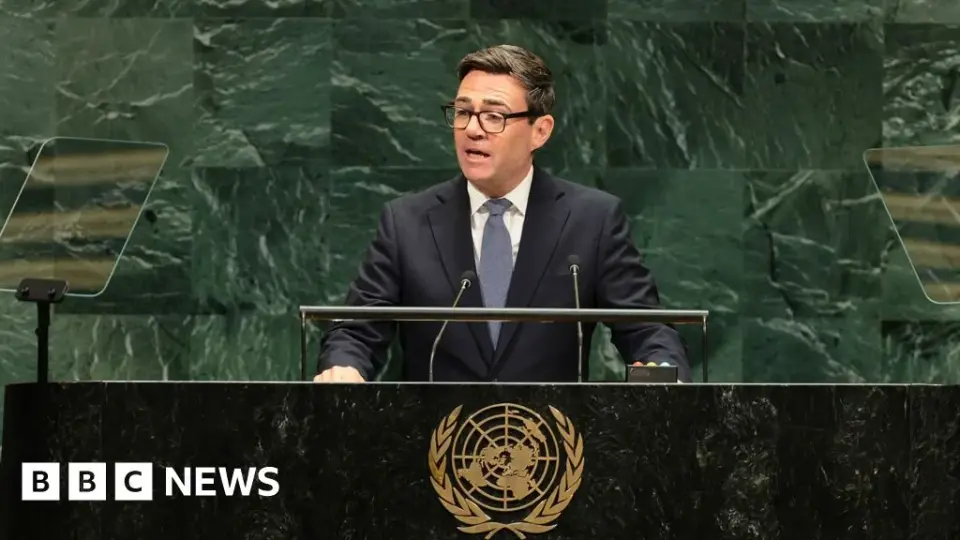
UK Prime Minister Andy Burnham announced the creation of a National Centre for Information Defence to combat Russian disinformation and pledged to lead efforts for global AI safety standards during his first UN General Assembly speech. While he framed Russia as the primary threat, critics note the role of US tech platforms in amplifying such content. The UK aims to broker international AI rules, though the US and China remain opposed to binding global frameworks.
Key points
- Burnham established a new National Centre for Information Defence to detect and disrupt AI-enabled disinformation campaigns from hostile states, citing Russian spending of approximately £1.3bn annually on information manipulation.
- The UK government pledged to push for a single set of global AI principles and standards, emphasizing transparency and safety, while highlighting the existing UK AI Security Institute.
- Burnham described the UK as an 'honest broker' between the US and EU on AI, noting that frontier AI poses significant risks that require international cooperation rather than unilateral control.
- The UK and US announced a new partnership focused on using AI to protect critical national infrastructure, despite differing regulatory approaches between the two nations.
- Burnham referenced the 2019 UK general election, alleging Russian interference, and warned that AI would multiply existing threats to democratic stability and social cohesion.
Background
This announcement follows a period of heightened concern regarding AI safety and information warfare. In September 2026, a coalition of over 20 countries, including Germany and Canada, proposed a declaration for mandatory pre-release testing of frontier AI models, though the US, China, and UK did not sign it. Earlier in the month, OpenAI urged the UK to implement binding safety rules, while UK Lords pushed for legal 'kill switch' powers. The current move by Burnham represents a shift towards proactive international engagement on AI governance, contrasting with previous voluntary testing models.
How outlets are covering it
BBC and UN News present Burnham’s speech as a decisive move to counter Russian 'industrial-scale' information warfare and establish global AI norms, emphasizing the UK’s role as a neutral mediator. The Guardian offers a critical perspective, arguing that Burnham’s focus on Russia ignores the complicity of US tech platforms and domestic extremists in amplifying disinformation. The Guardian notes that while the Kremlin funds the campaigns, US platforms like X provide the infrastructure for their spread, and domestic far-right actors actively participate in the discourse. BBC notes that Reform UK leader Nigel Farage accused the government of using the threat of foreign interference to clamp down on free speech, highlighting domestic political divisions on the issue.
Why it matters
The establishment of the National Centre for Information Defence signals a significant escalation in the UK’s approach to information security, integrating AI detection into national defense strategies. The push for global AI standards could reshape international tech governance, potentially influencing how major powers like the US and China regulate frontier models. However, the lack of US and Chinese support for existing AI declarations suggests that achieving binding global standards remains a complex diplomatic challenge, with implications for economic competitiveness and national security.
What to watch
The UK is expected to leverage its upcoming G20 presidency in Manchester to advance its agenda for global AI principles. Burnham has indicated that legislation may be necessary if voluntary measures fail to ensure transparency and safety. The new AI and Autonomy partnership with the US will likely focus on practical applications for infrastructure protection, while the UK continues to engage with other nations to build consensus on mandatory testing and human oversight of AI systems.
- UK to fight Russian disinformation and push new global AI standards, Burnham says BBC
- Is Burnham right to blame Russia for spreading online disinformation? BBC
- The Guardian view on Russian disinformation: a foreign threat that relies on UK complicity | Editorial The Guardian
- Kremlin says UK Burnham's decision to stir up anti-Russian sentiment in UN speech was short-sighted Reuters
- United Kingdom announces action on disinformation and global AI standards UN News
Want the full story? Read the original reporting
Read on BBC