
Ukraine's Kerch Bridge Strikes Sever Crimea's Supply Lifeline, Forcing Russia to Rely on Vulnerable Overland Routes
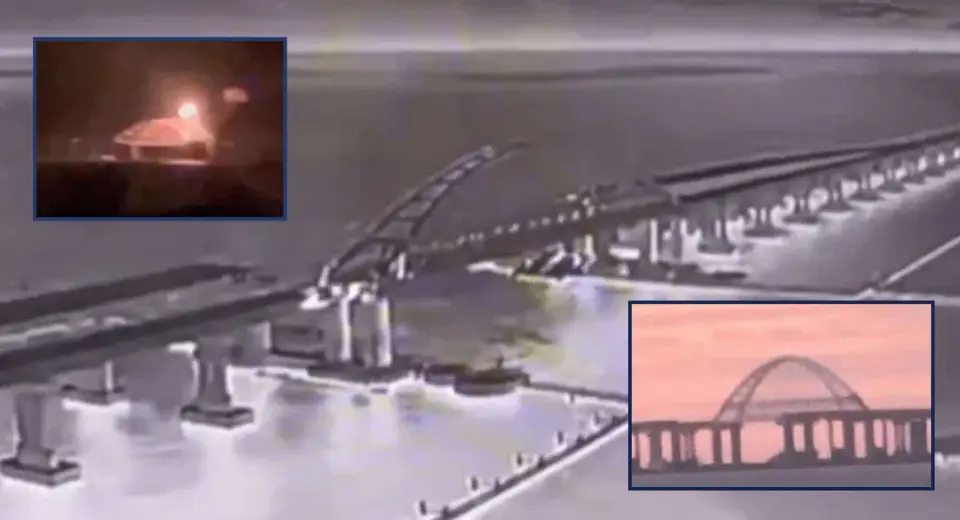
Ukraine's sustained strikes on the Kerch Bridge from November 16 to 19, 2026, have collapsed the road span and damaged the railway section, severing Russia's primary land link to occupied Crimea. The Institute for the Study of War (ISW) and Ukrainian Navy officials warn that Russian forces in the peninsula will face shortages of fuel and ammunition within one to three weeks. With the bridge compromised, Russia must rely on overland routes through occupied Donetsk and Zaporizhzhia oblasts, which are under constant threat from Ukrainian drone attacks. The strikes, which utilized custom drone relay networks to bypass Starlink restrictions, represent a significant logistical blow to Moscow's occupation infrastructure.
Key points
- Ukraine destroyed the road span of the Kerch Bridge on November 17, 2026, and damaged the railway section on November 19, 2026, using missiles and drones.
- ISW assesses that the destruction of the bridge will complicate Russia's ability to maintain its occupation and military basing in Crimea, with supply shortages expected between November 29 and December 13.
- Ukrainian Navy spokesman Dmytro Pletenchuk stated that Russia has no viable replacement for the bridge, as passenger boats cannot carry cargo and overland routes are exposed to drone strikes.
- The strikes utilized a mesh network of relay drones to guide missiles without relying on Starlink satellite communications, bypassing recent US restrictions on the technology.
- Ukrainian forces have also struck the M-14 highway and other road bridges in occupied Luhansk Oblast, further disrupting Russian supply lines to the front lines.
Background
The Kerch Bridge, completed in 2018 at a cost of $3.5 billion, has been a symbol of Russian control over Crimea since its annexation in 2014. It has been targeted by Ukraine multiple times since 2022, including a truck bomb attack in 2022 and a sabotage operation in 2025. Previous strikes had damaged but not destroyed the bridge, allowing Russia to repair it. The current strikes, however, have collapsed the road span and damaged the railway, raising concerns about the feasibility of repair. The bridge is a critical logistics hub for Russia's Black Sea Fleet and its military operations in southern Ukraine.
How outlets are covering it
The Institute for the Study of War (ISW) emphasizes the long-term logistical impact of the bridge's destruction, predicting that Russian forces in Crimea will face shortages of fuel and ammunition within one to three weeks. ISW notes that the bridge's destruction will complicate Russia's ability to maintain its occupation and military basing in the peninsula. Ukrainian Navy spokesman Dmytro Pletenchuk, cited by ISW, argues that Russia has no viable replacement for the bridge, as passenger boats cannot carry cargo and overland routes are exposed to drone strikes. The Wall Street Journal (WSJ) frames the strike as a 'miracle' for Ukraine, highlighting the vulnerability of Russian logistics and the growing frustration among European NATO members over US restrictions on Starlink. Ars Technica focuses on the technical aspects of the strike, noting that Ukraine used a mesh network of relay drones to bypass Starlink restrictions, demonstrating the adaptability of Ukrainian military technology. The sources agree on the significance of the strike but differ in their emphasis: ISW and the Ukrainian Navy focus on the logistical impact, WSJ on the geopolitical implications, and Ars Technica on the technical innovation.
Why it matters
The destruction of the Kerch Bridge is a significant blow to Russia's logistics and military operations in Crimea. The bridge was a critical supply line for fuel, ammunition, and equipment, and its destruction will force Russia to rely on overland routes that are vulnerable to Ukrainian drone attacks. The strike also demonstrates the adaptability of Ukrainian military technology, as Ukraine used a mesh network of relay drones to bypass Starlink restrictions. The long-term impact of the strike will depend on Russia's ability to repair the bridge and find alternative supply routes, but the immediate effect is likely to be a shortage of supplies for Russian forces in Crimea. The strike also has symbolic significance, as the bridge was a symbol of Russian control over Crimea and a key part of Putin's ambition to hold onto the peninsula.
What to watch
Russia will likely attempt to repair the bridge, but the timeline for repair is uncertain. Engineering experts have suggested that repairs could take up to two years, and any damage to the bridge's piers could extend that time. Russian repair efforts will also be at risk from future Ukrainian missile and drone attacks. In the short term, Russia will rely on overland routes through occupied Donetsk and Zaporizhzhia oblasts, which are under constant threat from Ukrainian drone attacks. Ukraine will likely continue to strike Russian supply lines and infrastructure in occupied territories, further disrupting Russian logistics. The long-term impact of the strike will depend on Russia's ability to repair the bridge and find alternative supply routes, but the immediate effect is likely to be a shortage of supplies for Russian forces in Crimea.
- Russia lost the Kerch Bridge's road span, and ISW expects Russian supply to occupied Crimea to suffer as drones keep burning trucks on the remaining road lifeline Euromaidan Press
- After Bridge Attack, Putin Says He Will ‘Not Be Negotiating’ Ukraine Cease-Fire The New York Times
- Opinion | Why Ukraine’s Kerch Bridge Strike Matters WSJ
- Ukraine strains Russian logistics with Crimean bridge strikes Reuters
- Ukraine blew up Putin’s bridge using relay drones to bypass Starlink limits Ars Technica
Want the full story? Read the original reporting
Read on Euromaidan Press