
French Student Protests Escalate into National Crisis Ahead of 2027 Election
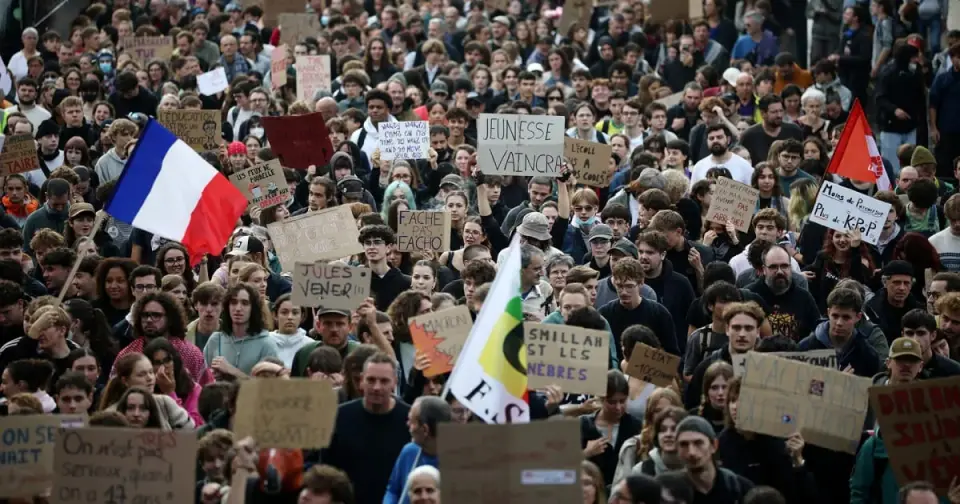
Massive student-led protests in France, sparked by education system failures and rising costs, have escalated into violent riots and mass arrests. The unrest, which has drawn hundreds of thousands of participants, is now influencing the upcoming 2027 presidential election by boosting support for both far-right and far-left candidates. While the government has conceded some demands, including changes to university admissions, police crackdowns and curfews have intensified, with critics blaming radical groups for the violence.
Key points
- Protests began on September 17 in Créteil over teacher shortages and spread to over 1,000 high schools nationwide by October.
- Violence escalated on October 17, with an estimated 550,000 to 800,000 people protesting, leading to looting, curfews, and over 2,700 arrests.
- The government responded by deploying 3,000 substitute teachers, rescinding tuition fee proposals, and promising to overhaul the Parcoursup admissions platform by 2028.
- Polling shows Marine Le Pen leading with over 30% support, while Jean-Luc Mélenchon’s far-left party jumped to second place with 17%, reflecting a polarized electorate.
- 81% of respondents blamed the government for the violence, and President Macron’s credibility has eroded as he is viewed as a 'lame duck' leader.
Background
This unrest follows a broader European wave of youth-led protests over education, housing, and cost of living, as noted in our recent coverage. France’s crisis is distinct in its scale and political impact, occurring against a backdrop of stagnant teacher pay, crumbling school infrastructure, and a generational divide over pensions and economic priorities.
How outlets are covering it
The Council on Foreign Relations emphasizes the structural failures of the French education system, such as teacher shortages and the 2018 Blanquer reform, as the root cause, while noting the electoral benefits for both extremes. BBC highlights the transnational nature of the protests, linking French unrest to similar movements in Italy, Spain, and Belgium, and stresses the role of social media in organizing. Both sources agree that violence has been exploited by political actors, but CFR focuses on the domestic electoral implications, while BBC frames it as part of a continent-wide crisis of legitimacy and polarized 'tribes' fueled by overlapping crises.
Why it matters
The protests threaten to reshape France’s political landscape, potentially leading to a far-right or far-left victory in 2027. The erosion of the social contract and the government’s limited options due to debt and a lame-duck presidency could set a precedent for other European nations facing similar youth-led unrest.
What to watch
Further protests are planned for Halloween weekend, with experts predicting the movement will intensify. The government faces pressure to address grievances while managing security, and the political extremes are likely to continue capitalizing on the unrest ahead of the April 2027 presidential election.
- What’s Behind the Protests and Riots in France, and What Comes Next Council on Foreign Relations
- Europe's youth take to the streets - they feel locked out of a promising future BBC
- 'Nobody heard us' – why Gen Z are leading protests across Europe Reuters
- France’s Permanent State of Emergency The Nation
- France’s Protests Fuel a Wider Fight Over Europe’s Future Jacobin
Want the full story? Read the original reporting
Read on Council on Foreign Relations