
India’s Youth Uprising Over Voter Purge Tests Modi’s Grip on Power
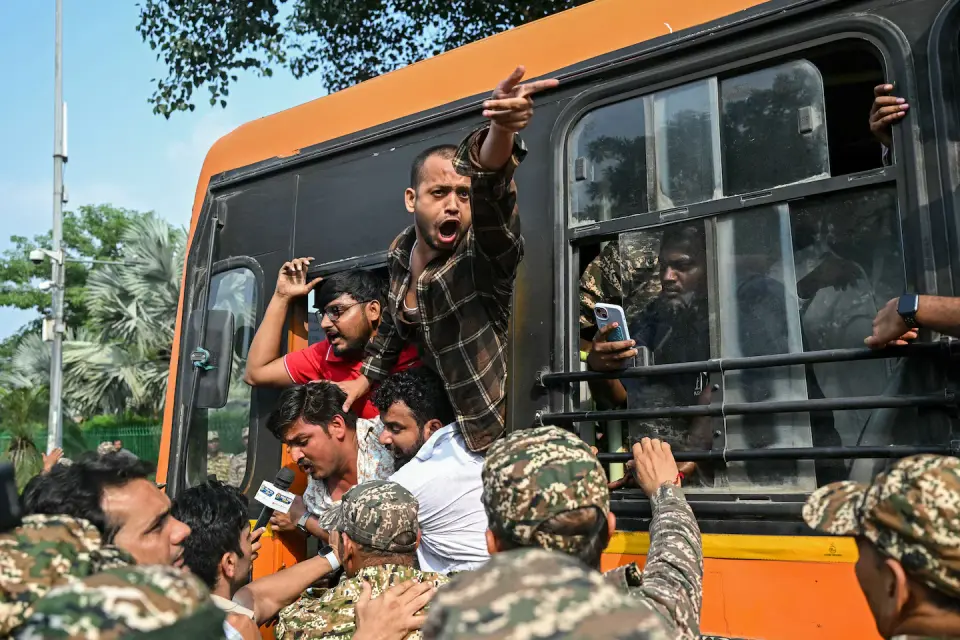
Massive youth-led protests in India are challenging Prime Minister Narendra Modi’s rule, triggered by a voter roll revision that removed 130 million names. The movement, led by the Cockroach Janta Party, has forced the resignation of the education minister and now demands the ouster of Election Commission chief Gyanesh Kumar. Authorities have responded with a heavy security crackdown in New Delhi, marking the most significant domestic challenge to Modi’s government since 2014.
Key points
- The Special Intensive Revision (SIR) of voter rolls removed 130 million names, a move critics call selective disenfranchisement to favor the ruling Bharatiya Janata Party (BJP).
- The Cockroach Janta Party, a youth-led group, has mobilized cross-class and cross-caste protesters, including former BJP supporters, in a broad-based movement against the government.
- Protests have escalated from education concerns in July to demands for the resignation of Election Commission chief Gyanesh Kumar and the annulment of the voter roll changes.
- Authorities have imposed a de facto lockdown in New Delhi, detaining thousands of protesters and intermittently disabling internet access to suppress the demonstrations.
- Analysts suggest the movement could curtail Modi’s political power or lead to an intraparty coup, though it is unlikely to topple the government before the 2029 elections.
Background
Modi’s BJP has maintained a commanding grip on Indian politics since 2014, winning consecutive elections despite criticism of Hindu nationalist policies and civil liberties rollbacks. Recent youth-led protests in South Asia, including in Sri Lanka, Bangladesh, and Nepal, have toppled regimes, raising concerns about similar instability in India. The current unrest follows a July protest over leaked state examinations that forced the resignation of the education minister, signaling the growing political muscle of the Cockroach Janta Party.
How outlets are covering it
The Washington Post emphasizes the unprecedented nature of the protests, highlighting the cross-class and cross-caste participation and the government’s heavy-handed response. The New Yorker, through an interview with activist Yogendra Yadav, focuses on the structural and political aspects of the voter roll purge, noting that the SIR process shifted the burden of registration onto individuals, disproportionately affecting the poor and women. Yadav also highlights targeted deletions of Muslim voters in West Bengal, which helped the BJP win a recent assembly election. Both sources agree that the movement represents a significant shift in public sentiment, with Yadav noting that the BJP is experiencing a panic-stricken response to the erosion of its popularity.
Why it matters
The protests signal a potential shift in India’s political landscape, challenging Modi’s long-standing dominance and raising concerns about democratic integrity. The voter roll purge, if not reversed, could disenfranchise a significant portion of the population, undermining the fairness of future elections. The government’s heavy-handed response may further erode public trust and set a precedent for authoritarian measures in a world’s largest democracy.
What to watch
The government is unlikely to restore the 130 million removed voters but may consider removing Gyanesh Kumar to appease protesters. The movement could lead to a transformation of political party structures, as seen in past Indian protest movements. The next national elections are scheduled for 2029, and the outcome of the current crisis could influence the political dynamics leading up to that date.
- India’s Modi faces unprecedented challenge to power as youth mobilize The Washington Post
- India’s government fails to crush Gen Z protests The Economist
- Is This the Beginning of the End of Indian Democracy? The New Yorker
- Despite lockdowns and thousands detained, India's youth-led protests grow Reuters
- Modi Defends India's Growing Cockroach Problem Foreign Policy
Want the full story? Read the original reporting
Read on The Washington Post