
Israel’s Oct. 27 Election: Far-Right Surge Meets Deadlocked Blocs and Arab Kingmakers
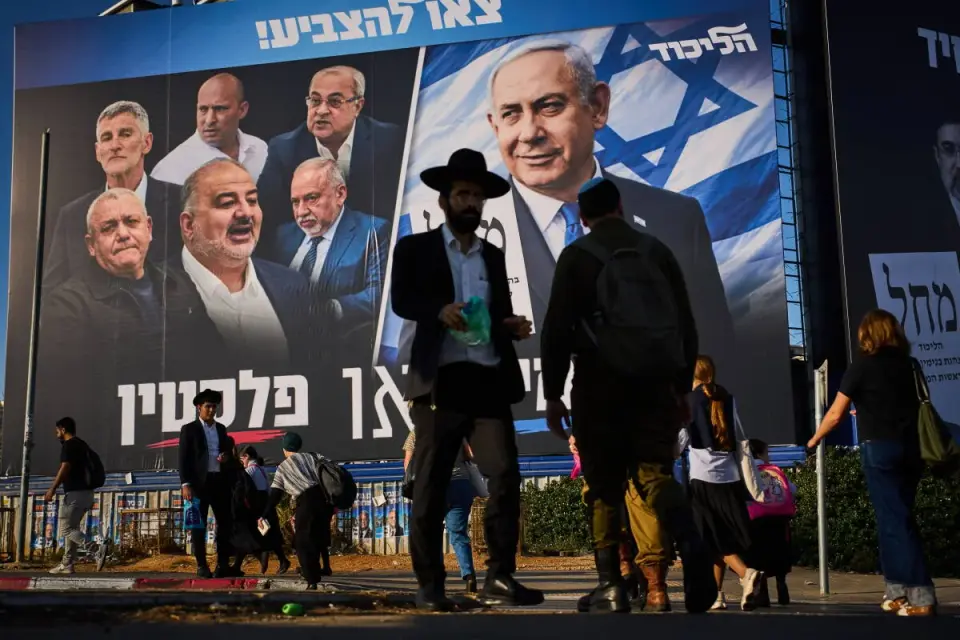
Israelis vote on October 27 amid a tight race between Prime Minister Benjamin Netanyahu and centrist Gadi Eisenkot. Polls show neither bloc can secure the 61 seats needed for a majority, making Arab-led parties potential kingmakers. A significant rightward shift among young voters has boosted far-right figures like Itamar Ben-Gvir, while center-left parties face physical harassment and declining support.
Key points
- Pre-election polls indicate a deadlock, with both the coalition and opposition blocs hovering around 51 seats, short of the 61 required to form a government.
- Arab-led parties, including Ra’am and the Joint List, are positioned as decisive kingmakers, though major Jewish-led parties have largely ruled out coalition partnerships with them.
- Itamar Ben-Gvir’s Jewish Strength party is predicted to win nine seats, outperforming the Democrats, the successor to the historic Labor party, which is forecast to take eight seats.
- Young Israeli voters, particularly those reaching voting age since 2022, skew heavily right-wing, with 75% identifying as right or center-right, fueling the rise of ethnonationalist politics.
- Center-left campaigners have faced physical violence and verbal abuse, prompting the Democrats party to train volunteers in non-violent de-escalation tactics.
Background
Recent legal challenges have restored the participation of major Arab lists after initial disqualification by the Central Elections Committee. This follows a period where far-right parties faced fewer barriers to entry. The current political landscape is shaped by the aftermath of the October 2023 Hamas attacks and a two-year hostage crisis, which has intensified security-focused rhetoric across the spectrum.
How outlets are covering it
AP News provides a structural overview of the key parties, highlighting the Democrats’ attempt to rebrand the left and the economic focus of the new Reservists-Economic party. The Guardian emphasizes the sociological shift, noting that young voters are socialized into ultra-nationalist views and that center-left parties are viewed as a radical fringe. Yahoo’s framing focuses on the permanence of the hard-right turn, contrasting the historical dominance of Labor with the current rise of extremist figures. While AP and Yahoo focus on party mechanics and polling numbers, The Guardian highlights the violent and hateful atmosphere surrounding the campaign, particularly regarding Arab citizens and peace negotiations.
Why it matters
The outcome will determine whether Israel continues its current trajectory of right-wing dominance and occupation expansion or shifts toward a more centrist approach. The potential for an Arab-led coalition or the decisive role of Arab parties in a close vote could alter the country’s domestic and foreign policy direction, particularly regarding the West Bank and Gaza.
What to watch
Voting takes place on October 27. The Supreme Court is expected to review the disqualification of certain Arab candidates. Coalition negotiations will begin immediately after the count, with the focus on whether any Jewish-led party will compromise on the traditional refusal to partner with Arab lists.
- A look at key parties in Israel’s Oct. 27 election seen as a referendum on Netanyahu AP News
- Arab voter turnout could make or break Netanyahu in Israeli election Reuters
- In shadow of war, Israelis to decide if hard-right turn is permanent Yahoo
- ‘There’s a lot of racism, a lot of hatred’: Far right gains predicted as Israel heads to the polls The Guardian
- 2026 Israeli elections: What you need to know The Times of Israel
Want the full story? Read the original reporting
Read on AP News