
Poland’s Constitutional Tribunal resumes work amid deepening political and religious crisis
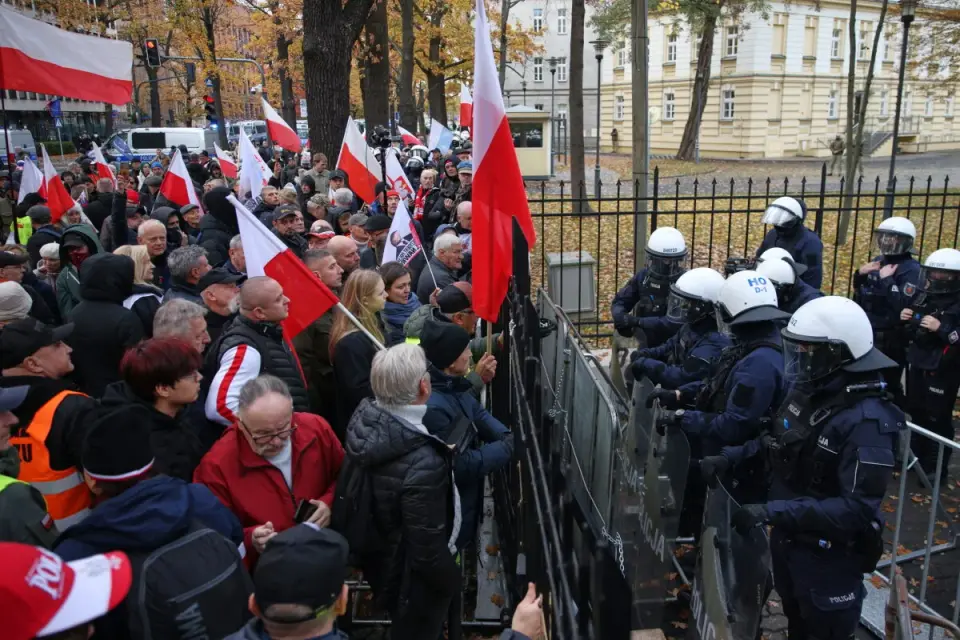
Poland’s Constitutional Tribunal held its first general assembly in months on November 3, with eight government-aligned judges declaring they have a valid quorum to resume operations. This move follows the controversial suspension of Tribunal President Bogdan Święczkowski by Judge Anna Korwin-Piotrowska on October 30, a decision that triggered riot police deployments, protests, and a physical confrontation when President Karol Nawrocki stormed the building. While the government frames the action as a necessary step to restore judicial independence and EU rule of law standards, the opposition and President Nawrocki condemn it as an illegal coup. The crisis has intensified political polarization ahead of the 2027 elections, drawn in international actors including Russia and the US, and prompted urgent appeals for reconciliation from Poland’s Catholic bishops.
Key points
- On November 3, eight judges elected by the current parliamentary majority convened a general assembly, declaring they met the quorum requirements to resume the Tribunal’s work after suspending President Święczkowski and his deputy.
- The suspension was announced on October 30 by Judge Anna Korwin-Piotrowska, who claimed authority as the most senior judge, citing alleged irregularities by Święczkowski. This followed President Nawrocki’s refusal to swear in new judges elected by parliament.
- President Nawrocki, aligned with the opposition Law and Justice (PiS) party, aborted a state visit to Senegal to return to Warsaw, where he physically forced his way into the Tribunal building on October 31, clashing with protesters and police.
- Prime Minister Donald Tusk defended the suspension as a necessary measure to restore the rule of law and judicial independence, while PiS leaders, including former Justice Minister Zbigniew Ziobro, labeled it a criminal attack on the constitutional order.
- The crisis has prompted international reactions, with the EU Commission supporting the government’s stance, the US Ambassador urging restraint, and Russia amplifying claims of a coup to destabilize Poland’s pro-European leadership.
- Polish Catholic bishops issued urgent appeals for peace and reconciliation, with Cardinal Konrad Krajewski urging fasting and prayer, warning that the dispute is leading to a profound state crisis and deepening social divisions.
Background
This crisis is the latest escalation in a decade-long battle over the control of Poland’s judiciary, which began when the PiS party took power in 2015. The EU Court of Justice ruled in 2023 that the Tribunal was no longer impartial due to PiS-era appointments. Tusk’s government, which took power in 2023, has repeatedly attempted to replace PiS-aligned judges but faced blockades from successive PiS-aligned presidents, including Nawrocki. The current standoff follows a series of failed attempts to secure a majority of judges friendly to the government, leading to the controversial suspension of the court’s leadership.
How outlets are covering it
The government and the European Commission view the suspension as a necessary, albeit difficult, step to restore the rule of law and judicial independence, arguing that PiS-era reforms undermined the Tribunal’s impartiality. In contrast, the PiS party and President Nawrocki frame the action as an illegal coup and a violation of the constitutional order, with Nawrocki accusing Tusk of using state power to seize control of the court. Human rights organizations, such as the Helsinki Foundation for Human Rights, criticize the methods used, noting that the legal basis for the suspension is doubtful and that the police presence escalated tensions. International perspectives vary: the US Ambassador urged restraint without interfering in internal affairs, while Russia amplified claims of a coup to undermine Poland’s pro-European stance. Religious leaders, including the Polish bishops, called for peace and reconciliation, warning that the crisis is deepening social divisions and eroding trust in state institutions.
Why it matters
The crisis threatens to further polarize Polish society ahead of the 2027 parliamentary elections, potentially hardening political divisions and making consensus on judicial reform even more difficult. It also raises questions about the stability of Poland’s rule of law and its alignment with EU norms, with potential implications for Poland’s standing in the European Union. The involvement of international actors, including Russia, adds a geopolitical dimension to the domestic dispute, while the religious appeals highlight the deep social and moral dimensions of the crisis. The resolution of this standoff could set a precedent for how Poland handles future conflicts between the executive and judicial branches, with significant consequences for the country’s democratic institutions and international relations.
What to watch
The November 3 general assembly is expected to decide on the future of the Tribunal and potentially on the immunity of Święczkowski, which could pave the way for his criminal prosecution. However, it is unlikely that all sides will accept the decisions, as PiS-aligned judges may not recognize the legitimacy of the new leadership or the quorum calculation. The crisis is expected to continue, with potential further escalations in political tensions and public protests. The government may pursue a complete reset of the Tribunal under revised rules, while the opposition may continue to challenge the legality of the suspension. International observers will closely monitor the situation for any signs of de-escalation or further conflict.
- What to know about the crisis around Poland’s Constitutional Tribunal AP News
- Russia Senses Opportunity in Polish Political Turmoil The New York Times
- Clash intensifies between Tusk and Nawrocki over Poland’s top court POLITICO.eu
- As Poland's constitutional crisis spills into streets, bishops plead for reconciliation National Catholic Reporter
- Russia trying to foment 'instability' in Poland, PM Tusk says Reuters
Want the full story? Read the original reporting
Read on AP News