
Record Turnout Marks Israel’s Pivotal Election as Netanyahu Faces Eisenkot in Tight Race
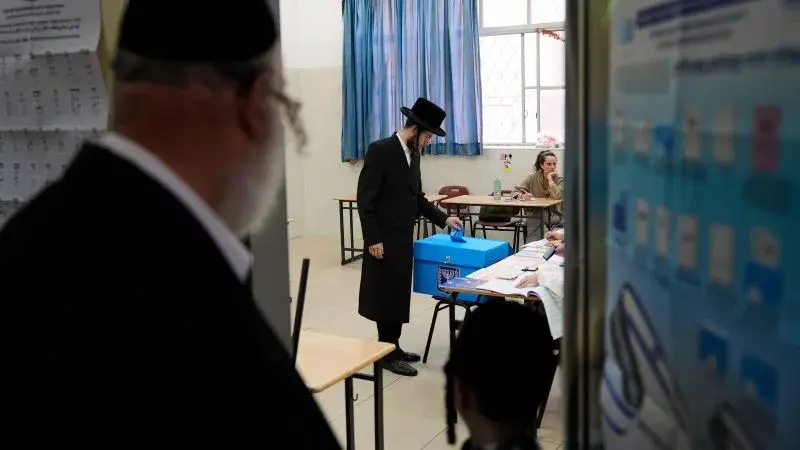
Israelis are voting in a historic election with the highest early turnout in 45 years. Prime Minister Benjamin Netanyahu seeks a seventh term against centrist challenger Gadi Eisenkot. Polls show a tight race, with neither side likely to secure a majority alone, making coalition negotiations the decisive factor. The vote is viewed as a referendum on leadership following the October 7, 2023, security failure and subsequent wars.
Key points
- Early voter turnout reached 16.68% by 10 a.m., the highest at that hour since 1981, according to the Central Elections Committee.
- Opinion polls are split: Channel 12 projects Eisenkot’s Yashar party with 23 seats versus Likud’s 21, while pro-Netanyahu Channel 14 projects Likud with 30 seats and Yashar with 20.
- No single party is expected to win the 61 seats needed to form a government, meaning the outcome will depend on post-election coalition building.
- Former Prime Minister Naftali Bennett and other opposition leaders have voted, calling for a 'historic correction' and a new social order.
- Far-right figures Bezalel Smotrich and Itamar Ben Gvir have voted in West Bank settlements, emphasizing security and settlement expansion.
Background
This is the first national vote since the October 7, 2023, Hamas-led attack and the subsequent wars in Gaza, Lebanon, and Iran. Previous coverage noted that polls indicated a likely stalemate, with Arab voter turnout potentially decisive. Recent reports highlighted deep societal fractures over judicial reforms, ultra-Orthodox conscription, and international isolation. Netanyahu’s outgoing government was the first in decades to complete a full term, relying on far-right and ultra-Orthodox partners.
How outlets are covering it
CNN emphasizes the historic nature of the turnout and the tight race, noting that the election is a referendum on Netanyahu’s leadership and his ability to form a coalition. The New York Times frames the election as a clash between hard-right nationalism and the country’s founding ideals, highlighting the ideological divide over the West Bank and Israel’s identity. While CNN focuses on the procedural and political mechanics, the NYT underscores the broader cultural and territorial stakes.
Why it matters
The outcome will determine whether Israel continues its current trajectory of nationalist and religious governance or shifts toward a more centrist, unifying approach. The election also tests Israel’s democratic resilience amid ongoing conflicts and international isolation. The result could influence regional stability, particularly regarding the West Bank and Gaza, and shape Israel’s relationship with the United States and other global powers.
What to watch
Polls close at 10 p.m. local time, followed by exit polls and initial projections. Coalition negotiations will likely take days or weeks, as no party is expected to win a majority alone. The formation of a new government will depend on alliances between Likud, Yashar, and smaller parties, including Arab and ultra-Orthodox groups. The outcome will also impact Israel’s domestic policies on security, judicial reform, and economic issues.
- Israel election latest: Early Israeli election turnout highest in decades as Netanyahu fights to keep power CNN
- Fastest turnout for half a century as Israelis pass wartime judgment on Netanyahu Reuters
- Watch Israel Election 2026: Eisenkot Casts Ballot as Opposition Seeks to Oust Netanyahu Bloomberg.com
- Two Visions, Two Israels, One Nation in the Balance The New York Times
- Netanyahu votes in Israel's election day Yahoo
Want the full story? Read the original reporting
Read on CNN