
Spain’s Sánchez Faces Likely Defeat as Far-Right Vox Poised to Join Government
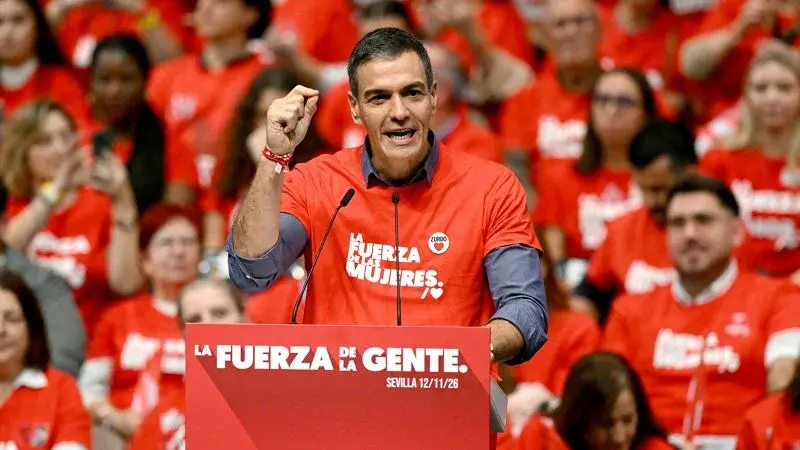
Spain holds a snap general election on November 29, 2026, after Prime Minister Pedro Sánchez’s coalition collapsed over a failed housing bill. Polls indicate the center-right People’s Party (PP) will likely lead a government with far-right Vox, potentially ending eight years of Socialist rule. Sánchez, who defied US President Donald Trump on Iran strikes and defense spending, faces domestic backlash over corruption scandals, train crashes, and rising living costs. Vox, led by Santiago Abascal, has surged by adopting radical anti-immigration and 'national priority' policies, positioning itself as the decisive kingmaker in a potential PP-Vox coalition.
Key points
- Spain’s snap election is scheduled for November 29, 2026, following the collapse of Sánchez’s coalition after failing to pass emergency housing measures.
- Polls show the center-right People’s Party (PP) leading, with the Socialist Workers’ Party (PSOE) trailing; a PP-Vox coalition is expected to secure a majority, potentially marking the first far-right participation in a Spanish government since 1975.
- Sánchez’s international reputation for defying Trump on Iran strikes and NATO defense spending contrasts with domestic fatigue over corruption, two fatal train crashes, and a housing crisis where rents have risen 44% since 2018.
- Vox has surged to nearly 20% support by adopting radical 'remigration' and 'national priority' policies, appealing to younger voters and economically discontented groups, while the PP has hardened its stance on immigration to retain voters.
- Sánchez’s inner circle faces corruption convictions, including his former transport minister, while his wife faces trial for alleged influence peddling; Sánchez denies wrongdoing but acknowledges his government’s failures in delivering on promises.
Background
Sánchez has led Spain for eight years, initially gaining power in 2018 by unseating a PP government embroiled in corruption. His tenure saw strong economic growth, with unemployment falling from 15% to 10%, but real wages stagnated amid rising costs. The 2023 election was narrowly won by Sánchez, but his coalition fractured due to internal divisions and failed budgets. The current election follows a period of domestic crises, including a 2025 power outage and migrant surges in Ceuta, which fueled far-right support. Spain’s post-Franco democracy, established in 1978, has historically excluded far-right parties from government, making a potential Vox-PP coalition a historic shift.
How outlets are covering it
CNN emphasizes Sánchez’s domestic failures and corruption scandals as drivers of his potential defeat, while highlighting his international stance against Trump. The New York Times focuses on Vox’s potential to become the first far-right party in a Spanish government since Franco, framing Abascal as a transformative figure. Al Jazeera highlights regional shifts in Andalusia, where a PP-Vox coalition already governs, as a preview of national trends, and notes voter skepticism toward all parties. The Guardian stresses Vox’s ideological shift toward European far-right alliances, including 'remigration' and 'national priority' policies, and its appeal to younger, economically discontented voters. All sources agree on the likely PP-Vox coalition but differ on emphasis: CNN on Sánchez’s personal failures, The Times on the historic far-right breakthrough, Al Jazeera on regional dynamics, and The Guardian on European far-right convergence.
Why it matters
The election outcome will determine whether Spain’s post-Franco democratic consensus, which excluded far-right parties from government, is broken. A PP-Vox coalition could shift Spain’s foreign policy toward the European center-right, weakening Sánchez’s role as a counterweight to Trump in the EU. Domestically, Vox’s potential influence could lead to radical changes in immigration, housing, and welfare policies, including 'remigration' and 'national priority' measures that may discriminate against non-Spanish citizens. The result also signals a broader trend of far-right consolidation in Europe, potentially emboldening allies in France, Italy, and Poland ahead of their 2027 elections.
What to watch
Voters will cast ballots on November 29, 2026. If polls are accurate, the PP will likely lead a government with Vox as a junior coalition partner or parliamentary supporter. Feijóo has indicated he may prefer a minority government with Vox’s backing, while Abascal seeks to leverage his party’s surge to implement radical policies. The outcome will determine whether Sánchez remains in power or is ousted, and whether Spain’s far-right enters government for the first time since 1975. Post-election, attention will turn to the feasibility of Vox’s 'remigration' and 'national priority' policies, and their impact on Spain’s EU relations and domestic social cohesion.
- Spain’s Sánchez stood up against Trump. His own voters may be about to bring him down CNN
- Spain’s Far-Right Era Ended in 1975. Will This Man Change That? The New York Times
- Spain general election 2026: polls, Sanchez vs Feijoo and what happens next Reuters
- Andalusia offers a glimpse into Spain’s future as far right gains ground Al Jazeera
- Why all of Europe should be watching as Spain’s far-right Vox closes in on power | Eoghan Gilmartin The Guardian
Want the full story? Read the original reporting
Read on CNN