
Trump, Xi, and Putin Hold Rare Trilateral Meeting in Shenzhen Amid Controversial Energy and ICC Agreements
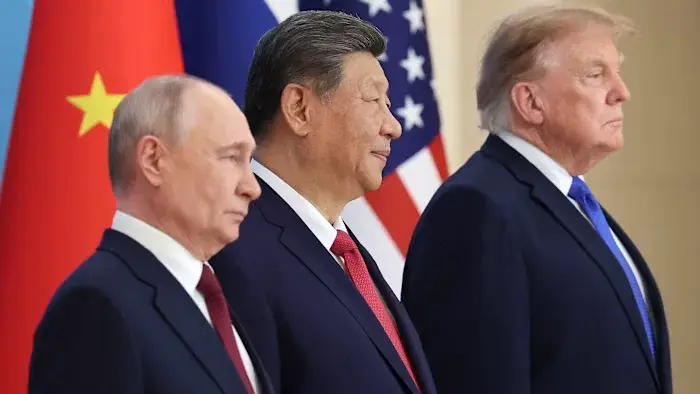
US President Donald Trump, Chinese President Xi Jinping, and Russian President Vladimir Putin held a rare three-way meeting in Shenzhen, China, on November 19, 2026, on the sidelines of the Asia-Pacific Economic Cooperation (APEC) summit. The leaders discussed global energy supplies, nuclear weapons, and the war in Ukraine. While the Kremlin described the atmosphere as positive, the meeting drew sharp criticism from US Republicans and European allies who argued that agreements to increase Russian energy exports would fund the war in Ukraine and that condemning the International Criminal Court undermines accountability for alleged war crimes.
Key points
- The trilateral meeting took place at Kylin Villa in Shenzhen, China, lasting approximately 90 minutes, with no joint or separate statements issued to reporters afterward.
- Prior to the three-way session, Trump met separately with Putin and then with Xi; the Kremlin’s Yuri Ushakov stated the atmosphere was good and that a full readout would follow.
- According to Politico, the leaders agreed to resolutions focused on increasing energy output and condemning the International Criminal Court and similar bodies, which drew backlash from US Republicans and European allies.
- Trump indicated he would discuss ending the war in Ukraine and denuclearization, while Xi called for the complete ban and destruction of nuclear weapons, noting that a nuclear war cannot be won.
- The meeting occurred amid ongoing tensions over AI chip exports, with the Trump administration recently issuing rules to curb China’s remote access to advanced US chips, and Beijing dismissing allegations of espionage involving former Nvidia CEO Jensen Huang’s associate.
- A US-China tariff truce is set to expire on January 10, 2027, and Trump expressed intent to ask China to do more for American farmers, citing China’s insatiable appetite for trade.
Background
The meeting occurred during the APEC summit in Shenzhen, a hub for China’s tech industry, which has faced scrutiny over alleged diversion of advanced US AI chips to China. The US and China had previously engaged in a trade war in 2025, with tariffs exceeding 100%, but have since sought to stabilize their economic relationship. The Kremlin and Chinese state media emphasized the positive tone of the meeting, while US officials highlighted concerns over AI regulation and trade stability.
How outlets are covering it
CBS News reported that the meeting was a rare face-to-face encounter for the leaders of three powerful nations, with Trump describing his relationship with Putin as strong and expressing optimism about future outcomes. The Kremlin’s Yuri Ushakov stated the atmosphere was good and that Putin left in an excellent mood. In contrast, Politico reported that the meeting drew backlash from US Republicans and European allies, who argued that agreements to increase Russian energy exports would fund the war in Ukraine and that condemning the International Criminal Court undermines accountability for alleged war crimes. Texas Senator John Cornyn called the energy agreement a big mistake, arguing it would not reduce fuel prices and would instead fund Russian aggression. CBS News also noted that the White House had previously said the war in Ukraine would not be discussed, but Trump later indicated it would be a topic, calling it my favorite subject. The outlets differ in their emphasis: CBS News focused on the diplomatic dynamics and Trump’s optimistic tone, while Politico highlighted the political backlash and the controversial nature of the agreed resolutions.
Why it matters
The meeting signals a shift in US foreign policy toward engaging with Russia and China on global issues, including energy and nuclear policy, despite ongoing conflicts in Ukraine and Iran. The agreement to increase energy output and condemn the International Criminal Court could weaken efforts to hold Russia accountable for war crimes and may impact global fuel prices. The meeting also highlights the complex dynamics of US-China relations, with ongoing tensions over AI chip exports and trade, and the potential for further negotiations on trade agreements and tariff truces. The trilateral meeting underscores the growing influence of China and Russia in global affairs and the challenges facing US leadership in balancing economic and security interests.
What to watch
The Kremlin is expected to publish a full readout of the meeting soon. The US-China tariff truce is set to expire on January 10, 2027, and Trump has indicated he will seek to sign new trade agreements with APEC members. The US and China are expected to continue discussions on AI policy and trade, while the US and Russia may engage in further talks on nuclear denuclearization and the war in Ukraine. The political backlash from US Republicans and European allies may influence future US foreign policy decisions and international cooperation on accountability for war crimes.
- China revels in Xi Jinping’s ‘Yalta 2.0’ moment Financial Times
- Trump, Xi and Putin sit down for a rare 3-way meeting in China, but appear to achieve little CBS News
- Trump's personalized diplomacy hits its limits with 3-way summit Reuters
- Trump’s world stage ‘triumph’ is turning into a domestic disaster The Times
- Trump’s trilateral draws backlash from Republicans and Ukraine allies Politico
Want the full story? Read the original reporting
Read on Financial Times