
United Russia Secures Record Supermajority in Contested Duma Election
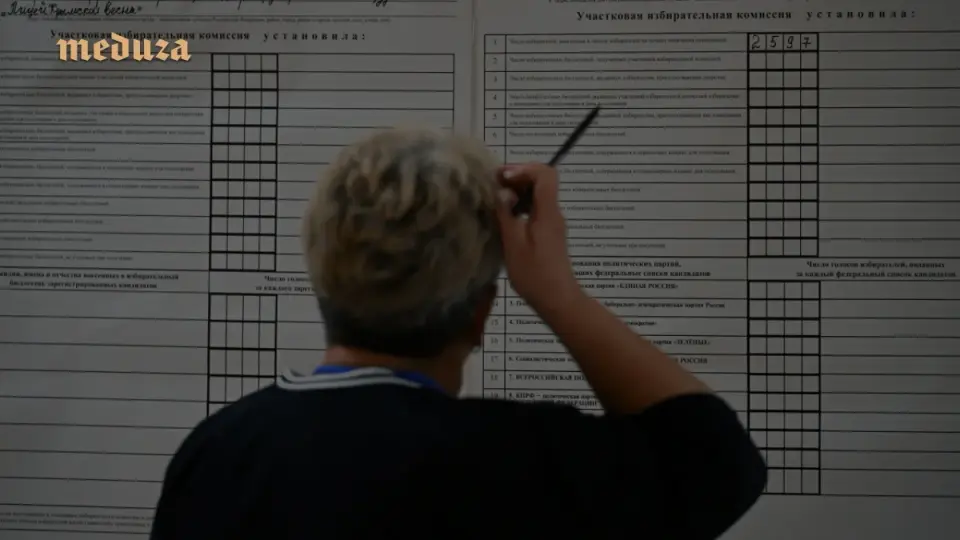
United Russia won a record 355 seats in the State Duma with 58% of the vote, achieving a supermajority in an election marked by 59% turnout. Kremlin insiders describe the results as achieved through 'dirty means,' including corporate mobilization and pressure on state employees. While the Communist Party placed second, the only anti-war party, Yabloko, was barred from the federal race. Western leaders condemned the vote as a sham, noting the exclusion of international observers and the inclusion of occupied Ukrainian territories.
Key points
- United Russia secured 58% of the vote and 355 seats, surpassing its 2016 record of 343 seats.
- Turnout reached 59.32%, the highest since 2011, driven by state-mandated 'corporate mobilization.'
- The Communist Party placed second with 14%, while LDPR and New People followed with 9% and 8%.
- A Just Russia narrowly cleared the 5% threshold after a reported direct signal from President Putin.
- 49 to 86 veterans of the war in Ukraine were elected to the Duma, depending on the source.
- Yabloko, the only registered anti-war party, was banned from the federal race by the Supreme Court.
Background
This election was the first parliamentary vote since Russia's 2022 invasion of Ukraine. Prior coverage indicated the Kremlin sought to legitimize the war through a high turnout and a dominant ruling party result. Earlier reports noted that Moscow's drone campaign was timed to end before the vote to project a 'picture of victory.' The current results confirm the anticipated dominance of United Russia, with the Kremlin using the outcome to signal public support for the war and its leadership.
How outlets are covering it
Meduza provides an insider view, citing Kremlin sources who admit the results were secured through 'very dirty means,' including pressuring state employees to vote and manipulating turnout figures. They note that the political bloc aimed for a turnout of 50% plus a margin but overshot, leading to complaints from regional officials. Al Jazeera and The Guardian focus on the international reaction, highlighting the condemnation from the EU and Western nations, who labeled the vote a 'sham' due to the exclusion of observers and the inclusion of occupied Ukrainian regions. The Guardian also emphasizes the military context, noting that 49 to 86 war veterans were elected, while Al Jazeera points out that the Communist Party's result was 5 percentage points lower than in 2021 due to Kremlin pressure to withdraw popular candidates. All sources agree on the final seat counts and the dominance of United Russia, but they differ in emphasis: Meduza focuses on the internal mechanics of the vote, while Al Jazeera and The Guardian focus on the geopolitical implications and the lack of genuine opposition.
Why it matters
The election results consolidate Vladimir Putin's grip on power, providing a mandate for the continuation of the war in Ukraine and potentially harsher domestic policies. The supermajority in the Duma reduces the likelihood of legislative opposition, while the inclusion of war veterans in parliament signals a shift toward militarizing the political elite. The exclusion of the only anti-war party and international observers undermines the legitimacy of the vote in the eyes of Western governments, potentially leading to further diplomatic isolation for Russia. The high turnout, achieved through state pressure, may mask public discontent with the war and economic conditions, creating a fragile stability that could be tested by future mobilization efforts or economic pressures.
What to watch
The new Duma will likely pass legislation supporting the war effort and the Kremlin's agenda, with little opposition. The inclusion of war veterans in parliament may influence military and foreign policy decisions. Western governments may impose further sanctions or diplomatic measures in response to the election. The Kremlin may use the results to justify increased mobilization or repression of dissent. The long-term impact on Russian society and the war in Ukraine will depend on the ability of the new Duma to manage economic and military challenges, as well as the response of the international community.
- Russia’s State Duma election delivered record turnout and a landslide for United Russia. Kremlin insiders say the results were achieved ‘through very dirty means.’ Meduza
- Pro-Putin party gets record 355 parliamentary seats, anti-war party a tiny regional foothold Reuters
- Party Behind Putin Claims 58% Support in Election Newser
- Putin’s party wins supermajority in Russia’s parliamentary vote Al Jazeera
- Putin consolidates grip on Russia as 49 Ukraine war veterans elected to parliament The Guardian
Want the full story? Read the original reporting
Read on Meduza