
Delhi Rally Draws Tens of Thousands as Opposition Demands Election Chief Resignation
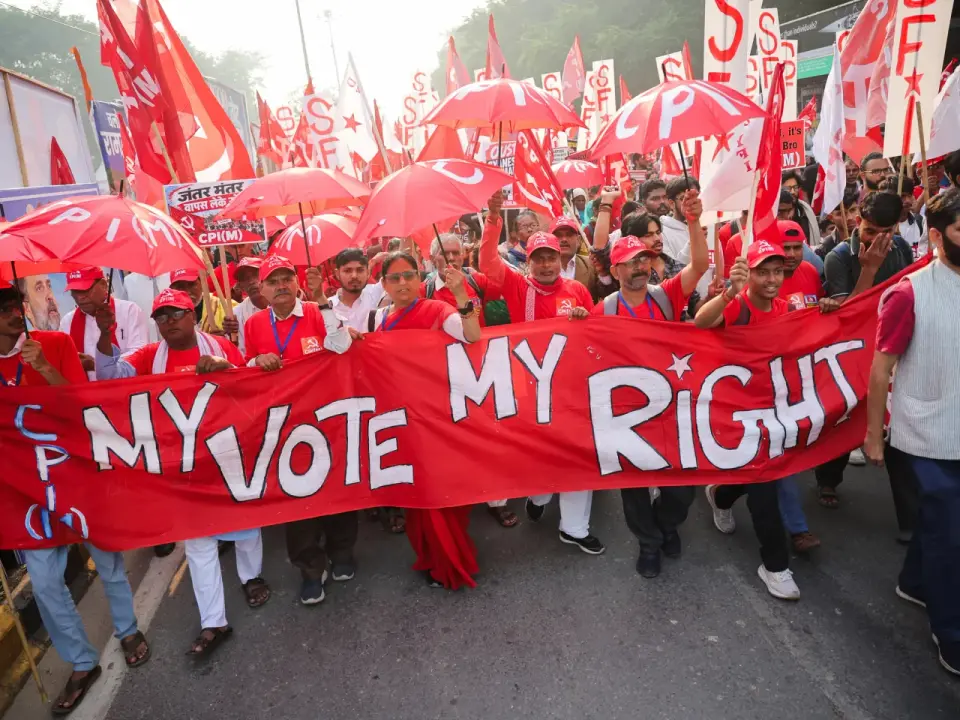
Tens of thousands of demonstrators gathered in New Delhi on November 1, 2026, to demand the resignation of Chief Election Commissioner Gyanesh Kumar. The protest, led by the INDIA opposition bloc and Congress leader Rahul Gandhi, targets the Special Intensive Revision (SIR) of voter lists, which removed over 130 million names. Opposition leaders allege the purge disproportionately affects minorities to benefit the ruling Bharatiya Janata Party (BJP), while the government and Election Commission deny bias, calling the revision a necessary cleanup of ineligible entries. The event followed a symbolic mock impeachment of Kumar and intensified amid a broader resurgence of anti-government dissent, including youth-led protests by the Cockroach Janta Party.
Key points
- The rally took place at Ramlila Maidan in New Delhi, as police had previously removed Jantar Mantar from the list of designated protest venues.
- Opposition leaders, including Rahul Gandhi and Mallikarjun Kharge, accused Gyanesh Kumar of committing 'treason' and 'vote theft' by overseeing a biased revision of electoral rolls.
- The Special Intensive Revision (SIR) removed over 130 million names from draft electoral rolls since last year, with critics alleging disproportionate impact on Muslims and other minorities.
- The Election Commission and BJP deny allegations of bias, stating the revision aims to remove duplicate and ineligible entries, and that wrongly deleted voters can re-register.
- The protest followed a symbolic mock impeachment of Kumar at Congress president Mallikarjun Kharge's residence, presided over by former Lok Sabha Speaker Meira Kumar.
- Youth-led Cockroach Janta Party (CJP) pledged support for the rally but did not send senior leaders, reflecting a trust deficit with establishment opposition parties.
Background
The voter roll controversy first emerged in 2025 but escalated into a national scandal in September 2026 after an Indian Express investigation reported irregularities and discord within the Election Commission over the SIR's implementation. Opposition parties, student organizations, and the CJP have staged near-daily demonstrations since late September, including a march to the Supreme Court on October 12. The current rally is part of a broader resurgence of anti-government dissent, including youth-led protests that forced the resignation of one of Modi's cabinet ministers earlier in 2026.
How outlets are covering it
Al Jazeera and BBC report that tens of thousands of demonstrators attended the rally, with Al Jazeera noting the presence of Communist Party of India supporters and BBC highlighting the deployment of thousands of police and paramilitary personnel. The Guardian emphasizes that turnout fell short of the one million predicted by Congress leaders, with empty seats visible and many attendees being party workers bussed in from other states. The Guardian also notes a trust deficit between the establishment opposition and the youth-led CJP, whose leaders pledged support but did not attend. All three sources report that the BJP and Election Commission deny allegations of bias, with BJP president JP Nadda calling the protest a 'calculated conspiracy to plunge the nation into anarchy.' The Guardian and BBC highlight that the rally occurred amid a broader resurgence of anti-government dissent, including youth-led protests that have challenged the Modi regime over the past 12 years.
Why it matters
The rally underscores deepening tensions between India's opposition and the ruling BJP over electoral integrity, with the SIR potentially affecting millions of voters ahead of the 2029 general election. The protest highlights concerns about democratic erosion and minority disenfranchisement, while the government's heavy security response and dismissal of the rally as 'anarchy' reflect the polarized political climate in India. The event also signals the growing influence of youth-led movements like the CJP, which have challenged the establishment opposition and the Modi government alike.
What to watch
Opposition parties are expected to continue protests and legal challenges against the SIR, with potential further Supreme Court petitions. The BJP and Election Commission may intensify their defense of the revision process, while the government may face increased scrutiny over police handling of protests. The outcome of the SIR and its impact on voter rolls will be closely monitored as a potential indicator of fairness in future elections. The relationship between the establishment opposition and youth-led movements like the CJP may also evolve, with potential for greater or lesser collaboration in future protests.
- Photos: Thousands join India’s opposition rally against election chief Al Jazeera
- India’s Congress Party Holds Mass Protest in New Delhi The New York Times
- Tens of thousands protest against Narendra Modi regime in Delhi The Guardian
- Rahul Gandhi: India's opposition rallies against voter roll revision exercise BBC
- ‘You can break a stick, not a bundle’: Thousands turn up for INDIA bloc rally from across the country The Hindu
Want the full story? Read the original reporting
Read on Al Jazeera