
Lancet Retracts 2006 Infant Death Report After SickKids Inquiry Confirms Falsified Toxicology Data
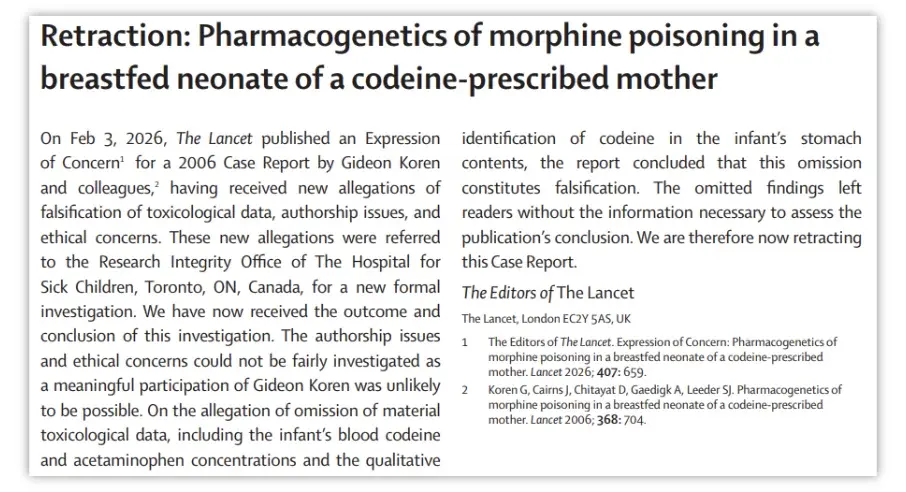
The Lancet has retracted a 2006 case report claiming an infant died from opioid poisoning via breast milk. A formal inquiry by the Hospital for Sick Children (SickKids) concluded that the report’s authors falsified the data by omitting critical toxicology results, including codeine and acetaminophen levels in the infant’s blood. The retraction follows new allegations from a former student and scrutiny of the author, Gideon Koren, whose work had influenced FDA guidelines against prescribing codeine to breastfeeding women. The paper, cited 464 times, is described by critics as a foundational but fabricated document in pediatric pharmacology.
Key points
- The Lancet retracted a 2006 case report by Gideon Koren regarding an infant’s death from opioid exposure through breast milk.
- SickKids conducted a formal inquiry and concluded that material toxicological data, including blood concentrations of codeine and acetaminophen, were omitted, constituting falsification.
- The retraction was triggered by new allegations submitted in January 2026 by Parvaz Madadi, a former PhD student and co-author of related studies.
- The original report was cited 464 times and served as key evidence for a 2017 U.S. FDA warning against prescribing codeine to breastfeeding women.
- Koren resigned from SickKids in 2015 after an investigation found his Motherisk lab’s results unreliable; he has six previous retractions, two involving codeine safety.
Background
This retraction is part of a broader pattern of scrutiny regarding Gideon Koren’s research. In 2015, Koren resigned from SickKids after an investigation found his Motherisk lab’s test results inadequate. In 2020, critics published a review arguing morphine toxicity via breast milk was unlikely, leading to retractions in Canadian journals. In January 2026, a New Yorker investigation renewed attention to the case, prompting the current retraction. Earlier archive items on bulk retractions by IEEE and Elsevier highlight ongoing concerns about research integrity, but this case involves specific allegations of data falsification in a high-impact clinical guideline.
Why it matters
The retraction undermines a key piece of evidence used in U.S. and Canadian guidelines regarding opioid prescriptions for postpartum women. If the foundational case report was falsified, the safety warnings derived from it may be based on incorrect data, potentially affecting clinical practices and patient safety assessments for breastfeeding mothers taking codeine.
What to watch
Researchers and medical bodies may review other studies by Koren and related guidelines. The FDA and other regulatory agencies may reassess their 2017 recommendations in light of the retraction. Further investigations into the 'Baby boy blue' case report and other related publications may follow as journals continue to audit their archives.
Want the full story? Read the original reporting
Read on Retraction Watch