
Dartmouth Provost's 2026 Writings Flagged as 96% AI-Generated by High-Accuracy Detector
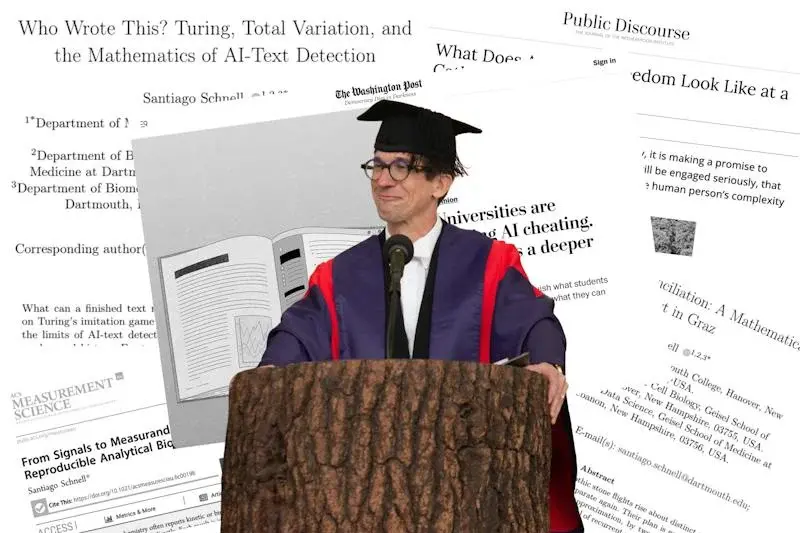
An investigation by The Dartmouth found that 96% of Provost Santiago Schnell's 2026 publications are flagged as AI-written by the Pangram detector, which has a near-zero error rate. While Schnell claims AI is used only for editing, his pre-2022 works were flagged as 100% human-written, highlighting a sharp contrast in his recent output.
Key points
- The Dartmouth analysis of nine of Schnell's 2026 works yielded a median 'AI-written' score of 96% using Pangram 4.0.
- Schnell's pre-2022 academic articles, tested against the same detector, all returned 100% human-written scores.
- Schnell admitted to using AI for language refinement and copyediting but denied it generated the core content.
- A Washington Post column by Schnell was flagged as 100% AI-written by a separate Semafor investigation.
- Schnell declined to provide AI logs to verify his writing process, citing academic norms regarding editor acknowledgment.
Background
This story follows earlier concerns about AI integration in academic and journalistic spheres. While previous archive items focused on geopolitical tensions and historical health issues, the current focus shifts to the integrity of human authorship in high-level professional writing. The contrast between Schnell's pre-2022 and post-2022 outputs serves as a case study for the impact of Large Language Models on professional standards.
Why it matters
The case raises critical questions about the definition of authorship in the age of generative AI. If a high-accuracy detector flags a university provost's work as predominantly AI-generated, it challenges the credibility of academic and journalistic standards. The discrepancy between Schnell's claims of 'assistive' use and the detector's findings highlights the difficulty in distinguishing between human oversight and machine generation, potentially impacting trust in expert opinions and institutional leadership.
What to watch
Institutions may face increased scrutiny regarding the disclosure of AI tools in professional writing. The Dartmouth's findings could prompt broader audits of academic and journalistic outputs for AI influence. Schnell's refusal to provide logs may lead to further debates about transparency and accountability in the use of AI for professional content creation.
Want the full story? Read the original reporting
Read on The Dartmouth