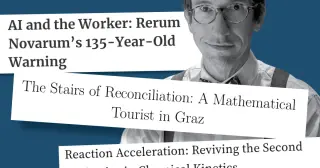
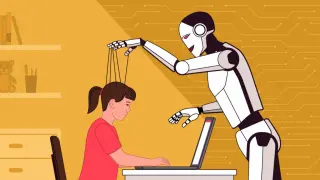
Dartmouth Provost Santiago Schnell faces backlash after student reporters found that his 2026 publications were largely AI-generated. Schnell claims he used AI only for editing, but critics argue this violates academic norms and undermines his public stance on AI in higher education.
A Dartmouth student opinion editor argues that College Provost Santiago Schnell should be fired for allegedly using artificial intelligence to draft major publications. The author contends that Schnell’s use of AI violates academic honor principles and undermines the institution’s credibility, especially given recent investigations by The Dartmouth and Semafor. While Schnell admits to using AI for editing, the article claims evidence suggests he relied on it heavily for writing. The piece also criticizes the broader administration for prioritizing AI partnerships and publicity over rigorous academic standards, suggesting this culture contributed to the provost’s conduct.
Cambridge’s chancellor Lord Chris Smith criticised a “racist feeding frenzy” around Jason Arday amid plagiarism allegations and his death, saying academic integrity must be upheld without harassing individuals; the controversy has spurred petitions, calls for inquiries, and ongoing investigations into Arday’s appointment and death.
A New York Times piece reveals a surge of AI agents being used by college students to autonomously complete online courses—logging into LMS like Canvas and Blackboard to take quizzes, watch lectures, write papers, and participate in discussions—often without active student involvement. Major AI tools reportedly won’t refuse or identify themselves on learning platforms, and universities struggle to police the practice, with some instituting restrictions while others avoid broad bans. Notable examples include the University of Chicago Law School’s device ban and Princeton’s reversal of its Honor Code after an AI cheating scandal, highlighting tensions between AI-enabled teaching, student privacy, and academic integrity.
Jason Arday, who became Cambridge’s youngest Black professor in 2023, has resigned as the university opens an inquiry into new information about his qualifications and honorary appointments, amid long-running plagiarism allegations and questions about his claimed fundraising feats. He says the public criticism has been intolerable, while Cambridge says the process will be fair. The Times reported potential fabrications in parts of his research, and Arday denied plagiarism but acknowledged some mistakes due to supervision gaps.
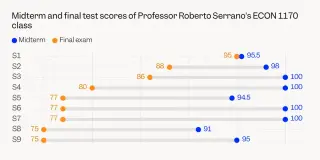
Brown University economist Roberto Serrano warned that AI-driven cheating has made cheating costs nearly zero; a take-home midterm produced unusually high scores, and when the final was moved to in-person, many top-scoring students saw their grades drop, prompting an academic integrity investigation and policy changes such as ending take-home components in future courses.
Brown University economics professor Roberto Serrano suspects a majority of students in his take-home midterm used AI to cheat, prompting him to make the final exam in-person; the midterm averaged about 96% while the final averaged 48.6%, leading to dozens dropping the course or failing. Brown’s handling of the case, including a Standing Committee on the Academic Code and a campus GenAI in teaching and learning initiative, has drawn criticism and highlighted broader questions about AI, detection, and policy in higher education.
A Brown University economics professor, Roberto Serrano, banned take-home exams after a mass cheating incident in his class: about 40 of 86 students earned 100 on a take-home midterm (average around 96), prompting a review. The professor then shifted to an in-person final; of 59 who took the final, 19 failed, with many submitting blank papers. Serrano, who is blind, argues the episode underscores the need for genuine learning and hard work, and he will void the midterm if the final’s grade distribution differs from the midterm’s.
Brown econ professor Roberto Serrano moved ECON 1170 to take-home midterms and an in-person final to test for AI-assisted cheating. The class swelled to 86; the midterm averaged 96 with 40 perfect scores, but the final’s in-person results among 27 takers averaged 48 (18 dropped, 9 did not attend). Notably, 22 of the 27 final-takers had scored 100 on the midterm. Serrano suspects widespread AI cheating and warns that if cheating becomes normalized, it could erode learning and society. Brown’s GenAI in Teaching and Learning report documents both usage and concerns.
GenAI has entered higher education, prompting educators to rethink what should be assessed. A Canadian study with 28 educators finds three boundary areas—prompting, critical thinking, and writing—where assessment rules must evolve. AI can enhance learning and accessibility but also complicates cheating and the spread of misinformation. Rather than blocking AI, campuses should update policies and train staff, adopting five design principles: explicit expectations for how GenAI is allowed to be used; process-focused assessment that values drafts and reflections over final outputs; tasks that require human judgment; developing students' evaluative judgment of AI; and preserving student voice. This signals a shift toward a post-plagiarism world where humans and AI co-create, with AI treated as a catalyst to strengthen integrity and learning.
GPTZero analyzed NeurIPS 2025 papers and found at least 100 fabricated citations across 51 papers that passed peer review, amid a 220% surge in submissions since 2020. The report details fake DOIs and author names, describes 'Vibe Citing' patterns, and notes that NeurIPS and ICLR consider hallucinated citations grounds for rejection or retraction, underscoring reviewer overload and the urgent need for stronger citation verification and fact-checking in AI research.
Teachers are increasingly using AI detection software to identify student use of AI in assignments, but these tools are often unreliable and can produce false positives, leading to concerns about fairness and accuracy. Schools are spending significant money on these tools despite research showing their limitations, and educators are advised to use them as supplementary rather than definitive evidence, focusing instead on teaching students to understand and adapt to AI technology.
A researcher was mistakenly listed as an expert on sex robots in a published paper, which was later retracted due to data inaccuracies and inappropriate search methods, highlighting issues of research misconduct and the importance of accurate bibliometric analysis.
An investigation uncovered over 1,500 research articles linked to a Ukrainian network, Tanu.pro, which is suspected of producing fake or low-quality papers and selling authorships, highlighting a significant issue of scientific misconduct in academic publishing.
A US-developed AI tool analyzed over 15,200 open-access journals, flagging more than 1,400 as potentially fraudulent, with over 1,000 confirmed as predatory, to help improve the integrity of academic publishing. The system uses website pattern analysis and is intended as a prescreening aid for human reviewers, not a replacement, and future accessibility to universities and publishers is planned.