
Merz and Macron Push for Rapid EU Trade Sanctions to Counter China
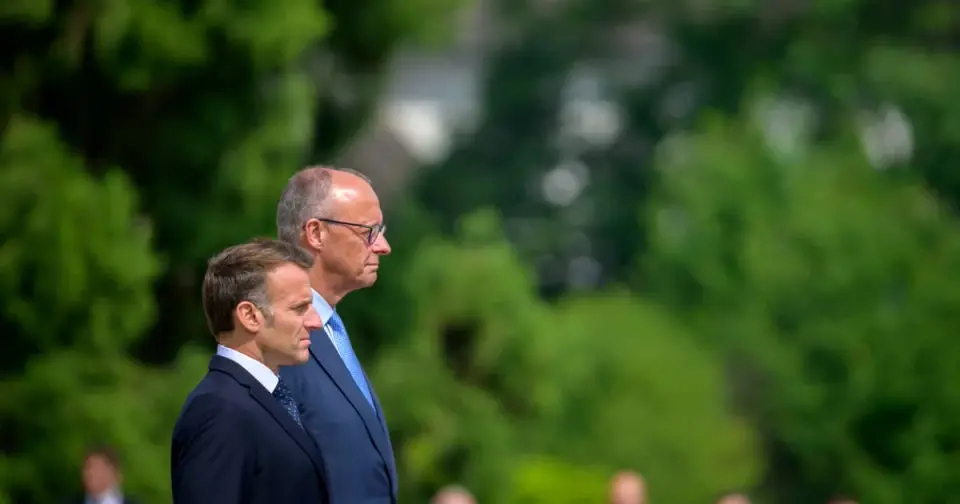
German Chancellor Friedrich Merz and French President Emmanuel Macron have urged the European Commission to adopt new, faster trade defense mechanisms to counter economic threats, primarily from China. Their joint letter argues that existing tools are insufficient and proposes a 'second-strike' instrument that would allow Brussels to restrict or cut off imports without requiring a qualified majority from member states. This move aims to empower Trade Commissioner Maroš Šefčovič ahead of critical negotiations in Beijing and an EU summit in October.
Key points
- Merz and Macron sent a joint letter on October 5, 2026, demanding the EU Commission be granted powers to act more quickly against trade threats.
- The proposal seeks to create a new legal instrument that could restrict or completely cut off imports from countries causing 'severe and systematic distortions' in the single market.
- The new mechanism would reverse the current voting process, requiring a 'reverse' qualified majority to block Commission actions, making it harder for individual capitals to veto trade measures.
- The initiative is described by a German official as a 'second-strike weapon' to counter U.S. Section 301 tariffs and Chinese dominance in critical mineral supply chains.
- The proposal coincides with Trade Commissioner Maroš Šefčovič’s visit to Beijing for final talks and an EU summit on October 15-16 to discuss outcomes.
- The move signals a significant shift in German policy, as Berlin previously opposed stronger EU trade defenses, now aligning with France on a more aggressive stance.
Background
This development follows months of stalled negotiations between the EU and China, highlighted by a record trade deficit of €1 billion per day. Recent archive coverage indicates that Beijing has threatened retaliation against potential EU restrictions, while the EU has faced pressure to address industrial closures caused by Chinese overcapacity. The current proposal builds on earlier Franco-German discussions launched in July 2026, where both leaders signaled a convergence toward a more aggressive trade posture to protect European industry from what analysts call a 'second China shock.'
Why it matters
The proposed shift in trade policy could fundamentally alter the EU's ability to respond to external economic coercion. By bypassing traditional consensus mechanisms, the bloc may achieve faster, more decisive action against perceived unfair trade practices. This move not only strengthens the EU's negotiating leverage with China but also signals a broader strategic pivot toward protectionism and supply chain diversification, potentially reshaping global trade dynamics and industrial policy within Europe.
What to watch
The European Commission is expected to develop a diversification instrument by the end of 2026 to reduce dependency on Chinese imports. EU leaders will convene in Brussels on October 15-16 to review the results of Šefčovič’s Beijing mission. The outcome of these talks will determine whether the new trade framework is adopted or if further negotiations are required to address the bloc's trade imbalance.
- Merz and Macron want the EU to hit back harder — and faster — against trade threats politico.eu
- Germany and France Push Trade Weapon to Bar China Access Bloomberg.com
- Germany and France Are Proposing a New Weapon to Counter Flood of Chinese Goods WSJ
- EU, China to hold Beijing talks to avert trade war CNA
- France, Germany push for EU rapid-response trade tool with likely focus on China Reuters
Want the full story? Read the original reporting
Read on politico.eu