
Scottish prosecutors link Turnberry golf course vandalism to terrorism charges
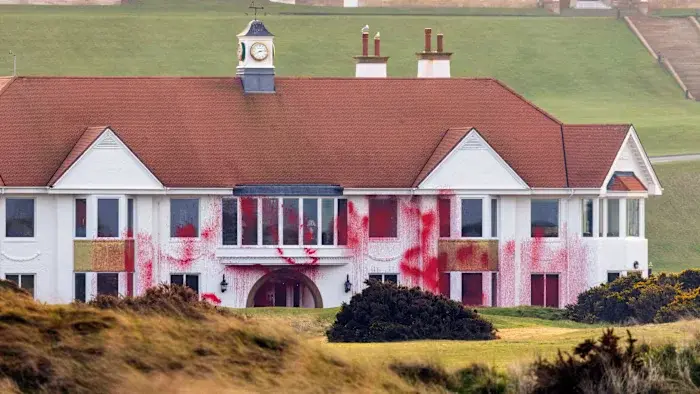
Scottish prosecutors have charged seven individuals with malicious damage to Donald Trump's Turnberry golf course in Ayrshire, alleging the acts were aggravated by a terrorist connection. The defendants, linked to the pro-Palestinian group Palestine Action, are accused of digging up turf, spraying weedkiller, and painting political slogans on the property in March 2025. The case highlights a widening crackdown on direct-action activists in the UK, with human rights groups and politicians criticizing the use of terrorism laws for political protests. The defendants are due to appear in the High Court in Glasgow, where they face potentially tougher sentences if convicted.
Key points
- Seven individuals, including Kieran Robson and Uzma Bashir, are charged with malicious damage to Trump's Turnberry golf course in Ayrshire, Scotland, with prosecutors alleging a terrorist connection.
- The alleged vandalism, which occurred in March 2025, involved digging up turf, spraying glyphosate, damaging sprinklers, and painting slogans such as 'Gaza is not 4 sale' on the property.
- The case is part of a broader UK trend of charging direct-action activists with terrorism-related offenses, drawing criticism from human rights groups and politicians like John McDonnell.
- Palestine Action, which was proscribed by the UK government last year, is involved in a legal battle, with co-founder Huda Ammori arguing the charges are an attempt to appease Trump and Netanyahu.
- The defendants are due to appear in the High Court in Glasgow on 31 August, with three facing additional charges for attempting to defeat the ends of justice by using false registration plates.
Background
This case follows a series of high-profile incidents in the UK where direct-action activists have been charged with terrorism-related offenses. In 2025, four members of Palestine Action were sentenced as terrorists for sabotaging a UK site of Israeli arms company Elbit Systems, and prosecutors sought to sentence five others under terrorism laws for vandalizing a Barclays branch in Burnley, though a judge ruled against it. The UK government proscribed Palestine Action last year, but the group's co-founder, Huda Ammori, has been granted permission to appeal the ban, with hearings scheduled for early November. The Turnberry case is part of a broader pattern of using terrorism laws to address political protests, which has drawn criticism from human rights groups and politicians.
How outlets are covering it
The Financial Times and The Guardian both report on the charges against the seven individuals, emphasizing the alleged terrorist connection and the potential for tougher sentences. The Financial Times highlights the political nature of the incident, noting that Trump described the vandals as 'terrorists' in March 2025. The Guardian provides additional details on the specific acts of vandalism, including the use of glyphosate and the damage to sprinklers. Al Jazeera focuses on the broader context of the US and UK crackdowns on pro-Palestine groups, noting that the US imposed sanctions on Palestine Action and Masar Badil. Al Jazeera also includes statements from Huda Ammori and John McDonnell, who criticize the use of terrorism laws for political protests. The sources generally agree on the facts of the case but differ in their emphasis, with The Financial Times and The Guardian focusing on the legal proceedings and Al Jazeera highlighting the international context and political criticism.
Why it matters
The case underscores the growing use of terrorism laws in the UK to address political protests, raising concerns about the suppression of dissent and the potential for disproportionate sentencing. It also highlights the international dimensions of the conflict, with the US imposing sanctions on pro-Palestine groups and the UK government's proscription of Palestine Action. The case may set a precedent for how political protests are handled in the UK, with potential implications for future direct-action campaigns.
What to watch
The seven defendants are due to appear in the High Court in Glasgow on 31 August, where they will face the charges of malicious damage with a terrorist connection. The outcome of the case could have significant implications for the use of terrorism laws in the UK and the legal status of Palestine Action. The Supreme Court hearings on the proscription of Palestine Action are scheduled for early November, which could further impact the group's legal standing.
- Alleged vandalism on Trump golf course linked to terrorism, Scottish prosecutors say Financial Times
- Seven charged with damaging Trump’s Scottish golf course accused of ‘terrorist connection’ The Guardian
- PA activists face ‘terror’ charges over Trump golf resort protest: Report Al Jazeera
- Palestine Action Activists Accused of Vandalism at Trump Turnberry Face Terrorism Accusation The New York Times
- Prosecutors say seven charged with damaging Trump Scottish golf course had 'terrorism connection' Reuters
Want the full story? Read the original reporting
Read on Financial Times