
Iran and UAE leaders pledge to 'turn the page' on conflict at BRICS summit
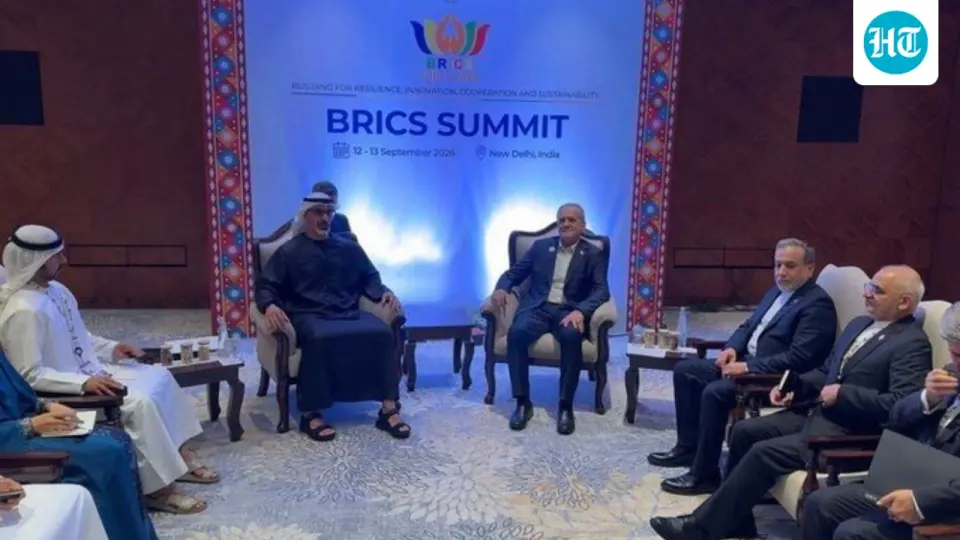
Iranian President Masoud Pezeshkian and UAE Crown Prince Sheikh Khaled bin Mohamed bin Zayed Al Nahyan held their highest-level meeting since the start of the West Asia war on the sidelines of the 18th BRICS Summit in New Delhi. The two leaders agreed to 'turn the page' on recent hostilities and focus on future cooperation, following a joint BRICS declaration calling for maximum restraint in the region. While Iran emphasized its refusal to surrender to US pressure, the UAE had previously suspended trade with Tehran, highlighting the complex diplomatic balancing act occurring in India.
Key points
- Pezeshkian and the UAE Crown Prince met in New Delhi, marking the first high-level contact between the two nations since the West Asia conflict began.
- The leaders agreed to 'turn the page' on past conflicts and build future cooperation, according to Pezeshkian.
- The 11-member BRICS bloc adopted a joint declaration urging maximum restraint, dialogue, and the protection of civilians in the Middle East.
- Iran stated it has no problem with the UAE but objected to US military bases in the region being used to attack Iran.
- US President Donald Trump said he 'does not care' if Gulf countries meet with Iran to discuss the Strait of Hormuz.
- The UAE had suspended trade and financial exchanges with Iran in August following a missile incident.
Background
The West Asia conflict escalated after the US and Israel launched joint strikes on Iran on February 28, 2026, killing Supreme Leader Ayatollah Khamenei. Iran retaliated by targeting US and Israeli interests, tightening control over the Strait of Hormuz, and attacking the UAE's Al Minhad Air Base in late August. These actions led to a suspension of trade between Iran and the UAE. The BRICS Summit in New Delhi provided a platform for these nations to engage in diplomacy, with India acting as a mediator between conflicting parties.
How outlets are covering it
Hindustan Times and NDTV both highlight the diplomatic breakthrough between Iran and the UAE, emphasizing the 'turn the page' rhetoric and the joint BRICS statement. CNBC focuses on Pezeshkian's defiant stance against the US, noting his refusal to surrender and his meeting with PM Modi. All sources agree on the significance of the BRICS declaration in urging restraint, but differ in emphasis: HT and NDTV focus on the Iran-UAE thaw, while CNBC highlights Iran's resistance to US pressure. Reuters, cited by HT, notes the challenge of finding language acceptable to both Abu Dhabi and Tehran.
Why it matters
The meeting signals a potential de-escalation in the West Asia conflict, which has disrupted global energy supplies and trade. The BRICS declaration underscores the bloc's role in promoting dialogue and stability, while the Iran-UAE rapprochement could reduce tensions in the Gulf and impact the Strait of Hormuz, a critical route for global oil.
What to watch
Gulf states and Iran are scheduled to meet in Oman on Monday to discuss security cooperation and the future of the Strait of Hormuz. The outcome of these talks will determine whether the 'turn the page' agreement leads to sustained peace or remains a temporary diplomatic gesture.
- Iran President, UAE Crown Prince meet on BRICS sidelines, back joint statement urging restraint in West Asia war | World News Hindustan Times
- Day After Talks In Delhi, Iran Says It Wants To "Turn The Page" With UAE NDTV
- Tehran won’t surrender to the U.S., Iranian President Pezeshkian says, as India's Modi urges dialogue and peace CNBC
- UAE, Iran Leaders Meet as Push to Resolve Hormuz Standoff Grows Bloomberg.com
- India's Modi stresses need to protect navigation, seafarers in talks with Iran's Pezeshkian Reuters
Want the full story? Read the original reporting
Read on Hindustan Times