
Colombia blames ELN for Cucuta bombing ahead of Espriella inauguration
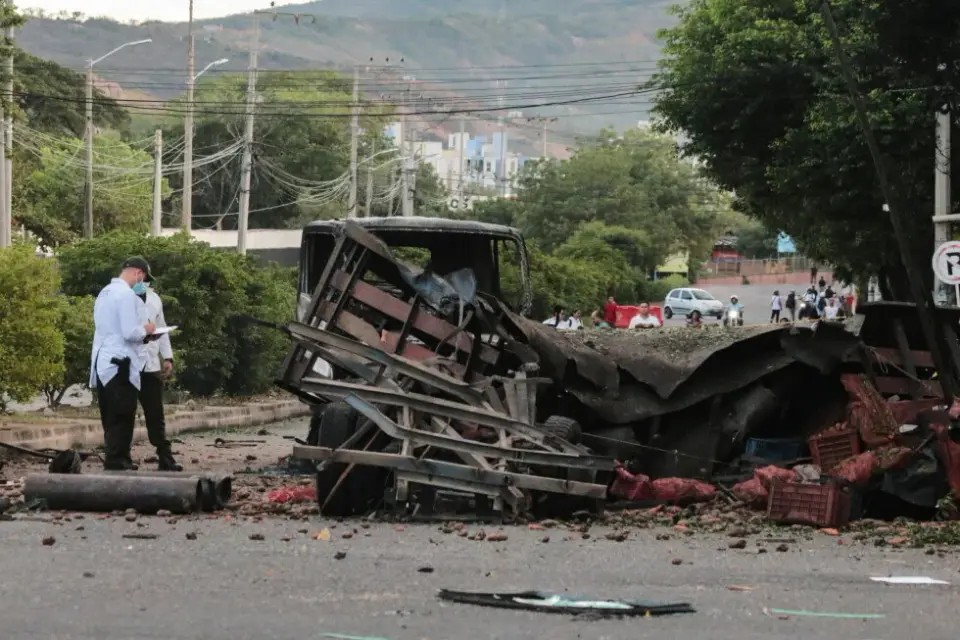
A truck bomb exploded outside a police base in Cucuta, Colombia, on Saturday, injuring 11 people and killing a police dog. The Colombian government blamed the National Liberation Army (ELN) for the attack, which occurred six days before the inauguration of right-wing President-elect Abelardo de la Espriella. Security officials warned of potential further violence in Bogotá and Cali as armed groups attempt to destabilize the transition of power from outgoing left-wing President Gustavo Petro.
Key points
- An explosive-laden truck detonated near a police station in Cucuta, Norte de Santander, on Saturday, injuring eight police officers and three civilians.
- The Colombian government, led by Defense Minister Pedro Sanchez, explicitly attributed the attack to the National Liberation Army (ELN), describing them as 'narcoterrorists' responsible for drug trafficking and violence.
- The incident occurred six days before Abelardo de la Espriella is scheduled to take office on August 7, succeeding Gustavo Petro, the country's first left-wing president.
- President-elect de la Espriella condemned the attack as 'cowardly' and vowed to intensify military operations against rebel groups and drug traffickers, including a proposed alliance with the United States and Israel.
- Authorities offered a reward of over $32,000 for information leading to the capture of those responsible, while warning that armed groups may target Bogotá and Cali to demonstrate operational capability.
- The attack highlights the escalation of violence in Colombia, where de la Espriella plans to end the peace negotiations initiated by the outgoing Petro administration.
Background
Colombia has faced decades of internal armed conflict involving rebel groups, paramilitaries, and state forces. The recent election of Abelardo de la Espriella marks a significant ideological shift from the peace-through-dialogue approach of President Gustavo Petro. De la Espriella, backed by US President Donald Trump, advocates for a militaristic strategy against drug trafficking, including the destruction of suspected drug-carrying aircraft and boats. The current violence follows a campaign period marked by political attacks, including the 2025 assassination of senator Miguel Uribe Turbay. The archive notes a broader global trend of violence against security forces, such as the recent militant raid in Pakistan's Balochistan, but the Colombian conflict is distinct in its long-standing civil war and drug trade dynamics.
How outlets are covering it
AP News and UPI report that the Colombian government officially blamed the National Liberation Army (ELN) for the Cucuta bombing, with Defense Minister Pedro Sanchez labeling the group as 'narcoterrorists.' Al Jazeera and CBS News note that while no group immediately claimed responsibility, several armed factions, including the ELN and FARC dissidents, remain active in the region. CBS News highlights the political context, noting that outgoing President Gustavo Petro has not commented on the attack while visiting Cuba, whereas de la Espriella has strongly condemned the incident. All sources agree on the casualty count of 11 injured (8 police, 3 civilians) and the timing relative to the August 7 inauguration. CBS News and Al Jazeera emphasize the shift in US-Colombia relations, with de la Espriella planning to strengthen military alliances, contrasting with Petro's previous diplomatic approach.
Why it matters
The attack signals a potential escalation in violence as Colombia transitions from a left-wing government focused on peace negotiations to a right-wing administration committed to military crackdowns. The timing, just days before the inauguration, suggests an attempt by armed groups to destabilize the new government or demonstrate continued operational capability. The international dimension, involving US support for de la Espriella's hardline drug policies, may further complicate regional security dynamics and impact Colombia's relationship with neighboring Venezuela and other Latin American nations.
What to watch
Authorities are expected to increase security measures in Bogotá and Cali ahead of the August 7 inauguration, with approximately 11,000 soldiers and police officers deployed. De la Espriella is set to cancel the peace talks initiated by Petro and implement hardline anti-drug policies, including the destruction of suspected drug-carrying vehicles. The Colombian government will likely continue investigations into the ELN's involvement, while armed groups may issue further warnings or carry out additional attacks to disrupt the transition of power.
- Truck explodes outside Colombia police base, injuring 11 officers and killing a dog AP News
- At least 11 wounded by Colombia car bomb days before presidential election Al Jazeera
- Bombing next to police station in Colombia injures 11, days before presidential inauguration CBS News
- Colombia terrorist attack injures 11, kills police dog upi.com
- 11 people hurt in truck bombing in Colombia, days ahead of inauguration of pro-Israel president-elect The Times of Israel
Want the full story? Read the original reporting
Read on AP News