
Israeli Election Deadlock Leaves Netanyahu and Eisenkot Short of Majority
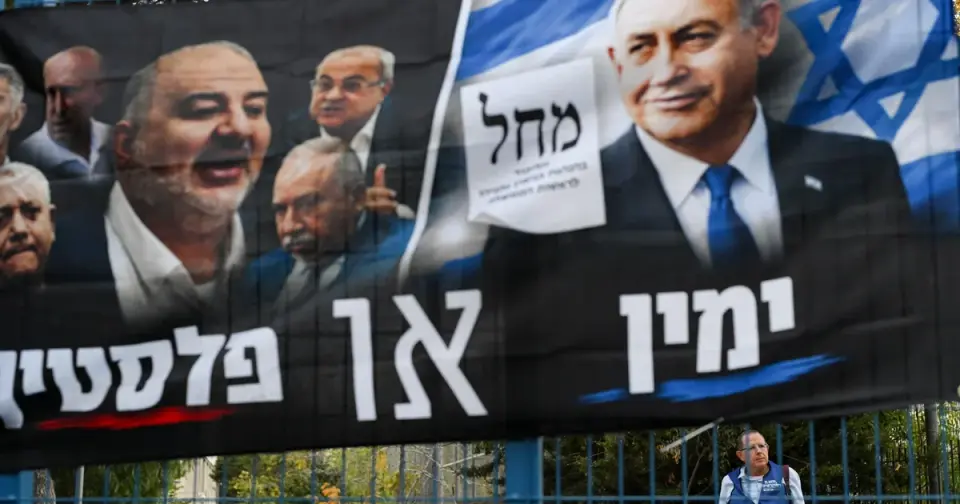
Israel’s October 27 election ended in a stalemate, with neither Benjamin Netanyahu’s coalition nor Gadi Eisenkot’s opposition bloc securing the 61 seats needed to form a government. Early results show Likud leading with 20.6% of the vote, while Yashar holds 15.9%. Arab parties achieved a historic 17 seats, becoming potential kingmakers. President Isaac Herzog must now decide who to task with forming a coalition, facing a 28-day deadline before new elections may be required.
Key points
- Netanyahu’s Likud party leads with 20.6% of the vote, but his broader coalition holds only 54 seats, falling short of the 61-seat majority.
- Gadi Eisenkot’s opposition bloc holds 49 seats, also lacking a majority, with Yashar party polling at 15.9%.
- Arab parties, including Raam and Joint List, won 17 seats, their highest total ever, driven by record turnout among the 20% Arab population.
- President Isaac Herzog faces a difficult choice in selecting a prime minister, as neither bloc can easily form a government without breaking pre-election vows regarding Arab alliances.
- Turnout reached 77.7%, the highest since 1999, reflecting a high-stakes vote amid ongoing regional conflicts and the aftermath of the October 2023 attacks.
Background
This election follows three years of war on multiple fronts since the October 7, 2023, Hamas attacks, which Israel’s authorities acknowledged as its most catastrophic security failure since 1948. Previous polls in October 2026 predicted a deadlock, highlighting the pivotal role of Arab voter turnout. The current political landscape is shaped by Netanyahu’s hard-right coalition, which includes ultra-Orthodox and ultranationalist parties, and an opposition bloc united primarily by the desire to remove Netanyahu from power.
How outlets are covering it
CBS News and The New York Times emphasize the immediate political gridlock, noting that both leaders claimed victory in late-night speeches despite lacking a majority. Al Jazeera highlights the 'polarized puzzle,' pointing out that while the opposition bloc wants Netanyahu out, many members refuse to ally with Arab parties, creating a strategic dilemma. Politico notes a contrasting global perspective, suggesting that regardless of the outcome, American public indifference to Israeli politics may limit the election’s impact on U.S.-Israel relations. Analysts cited by Al Jazeera and CBS News disagree on the likelihood of a unity government versus a minority coalition, with some viewing a Netanyahu-Eisenkot unity deal as a viable path to avoid new elections.
Why it matters
The outcome determines whether Israel will face weeks of coalition negotiations, a second round of elections, or a shift in its regional security doctrine. The historic success of Arab parties could force a re-evaluation of coalition norms, potentially altering Israel’s domestic politics and its approach to conflicts in Gaza, Lebanon, and Iran. The stalemate also raises questions about the stability of the caretaker government and the potential for renewed military escalation under Netanyahu’s continued influence.
What to watch
President Isaac Herzog will consult party leaders to determine who has the best chance of forming a government. The chosen candidate has 28 days to build a coalition, with a possible 14-day extension. If no government is formed, the Knesset will be dissolved, and new elections will be held. Final vote counts, including ballots from military and diplomatic personnel, are expected by Friday, with official results published on November 4.
- No clear winner in Israeli election as polls show race headed toward stalemate, negotiations on forming government CBS News
- Israel Election Results Live Updates: Exit Polls Show No Clear Winner The New York Times
- Netanyahu survives another day with unexpectedly clear backing of Israeli Jews Reuters
- Poll shows Israel’s looming challenge: American indifference Politico
- Israel’s election: The battle between change and anti-Palestinian sentiment Al Jazeera
Want the full story? Read the original reporting
Read on CBS News