
Tag

Atom Interferometry

All articles tagged with #atom interferometry

Quantum Galileo Interferometer Confirms Einstein's Equivalence Principle in Free Fall
science2 months ago

Quantum Galileo Interferometer Confirms Einstein's Equivalence Principle in Free Fall

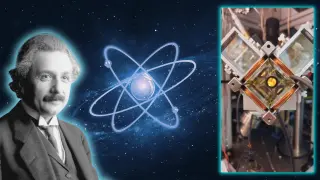
An international team led by Ron Folman at Ben-Gurion University has successfully tested the quantum phase of free fall, confirming that Einstein's equivalence principle holds for quantum superpositions. Using a new device called the Quantum Galileo Interferometer, researchers split rubidium atoms into two paths—one falling freely and one held stationary—to measure the resulting phase difference. The results, published in Science Advances, show a 2.5% deviation from theoretical predictions, marking a significant step toward understanding the interface between quantum mechanics and gravity.

Quantum Galileo Interferometer Confirms Einstein’s Equivalence Principle for Falling Atoms
science2 months ago

Quantum Galileo Interferometer Confirms Einstein’s Equivalence Principle for Falling Atoms

An international team led by Ben-Gurion University of the Negev has directly observed gravity’s effect on a quantum object for the first time. Using ultracold rubidium atoms, researchers split atomic waves into two paths: one held stationary by magnetic forces and the other allowed to fall freely. The resulting interference pattern matched predictions from Einstein’s equivalence principle, confirming that quantum mechanics and general relativity remain compatible at this scale. Published in Science Advances on September 2, the study does not prove gravity is quantum but validates the consistency of current theories.

First Direct Observation of Quantum Gravity Phase Confirms Einstein’s Equivalence Principle
science2 months ago

First Direct Observation of Quantum Gravity Phase Confirms Einstein’s Equivalence Principle

An international team of physicists has directly observed the quantum phase of a freely falling atom, confirming that Albert Einstein’s equivalence principle holds true at the quantum scale. Published in Science Advances on September 2, 2026, the study utilized a new instrument called the Quantum Galileo Interferometer to split the wave function of ultracold rubidium atoms. One part of the wave was held stationary while the other fell under gravity. The resulting interference pattern matched theoretical predictions, marking the first direct measurement of this specific quantum gravitational effect. While this does not unify quantum mechanics and general relativity into a single theory, it provides a crucial experimental bridge between the two frameworks.

Prototype differential atom interferometer overcomes laser noise to probe dark matter and primordial gravitational waves
science4 months ago

Prototype differential atom interferometer overcomes laser noise to probe dark matter and primordial gravitational waves

A tabletop prototype using two ultracold strontium atom clouds demonstrates a differential atom interferometer can cancel laser phase noise, revealing faint signals that could indicate dark matter or primordial gravitational waves. This experimentally confirms a key principle for future large-scale quantum sensors (AION) and paves the way for scaling to facilities at CERN or Fermilab to explore new physics.

X-37B Spaceplane Returns with Quantum GPS Tech on USSF-36 Mission
defense-and-space1 year ago

X-37B Spaceplane Returns with Quantum GPS Tech on USSF-36 Mission

The US military's X-37B spaceplane has launched on its eighth mission, carrying a quantum GPS alternative that uses atom interferometry to measure position precisely, potentially allowing navigation without traditional satellite systems. This technology, tested in 2025, could enhance future spacecraft and aircraft navigation, raising strategic concerns for China and the US about satellite dependency in warfare.

Quantum Navigation: US Military's Next-Gen Spaceplane Technology
technology1 year ago

Quantum Navigation: US Military's Next-Gen Spaceplane Technology

A US military spaceplane, X-37B, will test a quantum inertial sensor using atom interferometry during its upcoming mission, aiming to provide a highly sensitive, GPS-independent navigation system for space and other environments where GPS is unreliable or unavailable, marking a significant advancement in quantum technology applications for aerospace.