
Mechanophore-crosslinked polymers boost energy absorption under ultrafast impacts
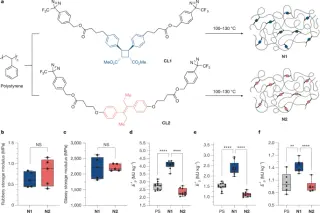
Embedding a small fraction of force-sensitive mechanophores as cross-links in common polymers reverses the usual brittleness of cross-linked networks, enabling significantly greater ballistic energy dissipation at strain rates above 10^7 s^-1. The mechanism features a force- and adiabatic-heating-driven local thermoset-to-thermoplastic transition triggered by mechanophore scission, allowing viscoplastic deformation at the impact site while preserving surrounding integrity. Demonstrated in glassy polystyrene and rubbery styrene–butadiene–styrene, the approach broadens the design space for impact-resistant, commodity polymers.