US businesses are increasingly adopting cheaper open-weight AI models to manage spiraling IT costs, shifting away from proprietary frontier systems. This trend, driven by both financial necessity and data sovereignty concerns, is reshaping the AI market and challenging the dominance of major US labs.
Yang Zhilin, the 34-year-old cofounder of Moonshot AI, spearheads the development of Kimi K3, an open-weight AI model touted to rival top US models in capability while costing less, signaling a milestone for China in the AI race. Yang’s background spans Tsinghua, Carnegie Mellon, and roles at Google Brain and Meta, with contributions to Huawei’s PanGu and Wu Dao before launching Moonshot AI in 2023. The company has attracted major Chinese investors like Alibaba and Tencent and emphasizes scaling as the path to progress, with Kimi K3 boosting Moonshot AI onto the global stage and sparking discussion about talent mobility and immigration policy in tech’s future landscape.
New analyses suggest Chinese AI models like Alibaba's Qwen3 and DeepSeek steer answers toward a pro-Beijing stance, with Qwen3 instructed to emphasize China’s achievements and avoid negatives, while other countries receive neutral treatment; a separate Estonia intelligence report accuses DeepSeek of concealing information and weaving Chinese propaganda into responses, underscoring how our AIs mirror their developers' biases.
DeepSeek’s open-weight R1 stunned markets by matching elite LLMs at a fraction of the cost, triggering a $750 billion drop in the S&P 500 and a $590 billion hit to Nvidia on one day in 2025. Yet the story didn’t end there: U.S. hyperscalers plan over $600 billion in AI infrastructure for 2026, while Chinese firms push efficiency with open-weight models like Alibaba’s Qwen, seeding global adoption and capital inflows back to China. Critics say the real change is on the Chinese side, where cheaper, efficient architectures and state-driven AI policy are reshaping the race, even as the U.S. maintains a hardware edge and export controls. The long-run winner may hinge on whether scale or smarter design proves most valuable.
Shares of DeepSeek's rival doubled in their debut as Chinese AI companies rush to list on the stock market, reflecting strong investor interest in the sector.
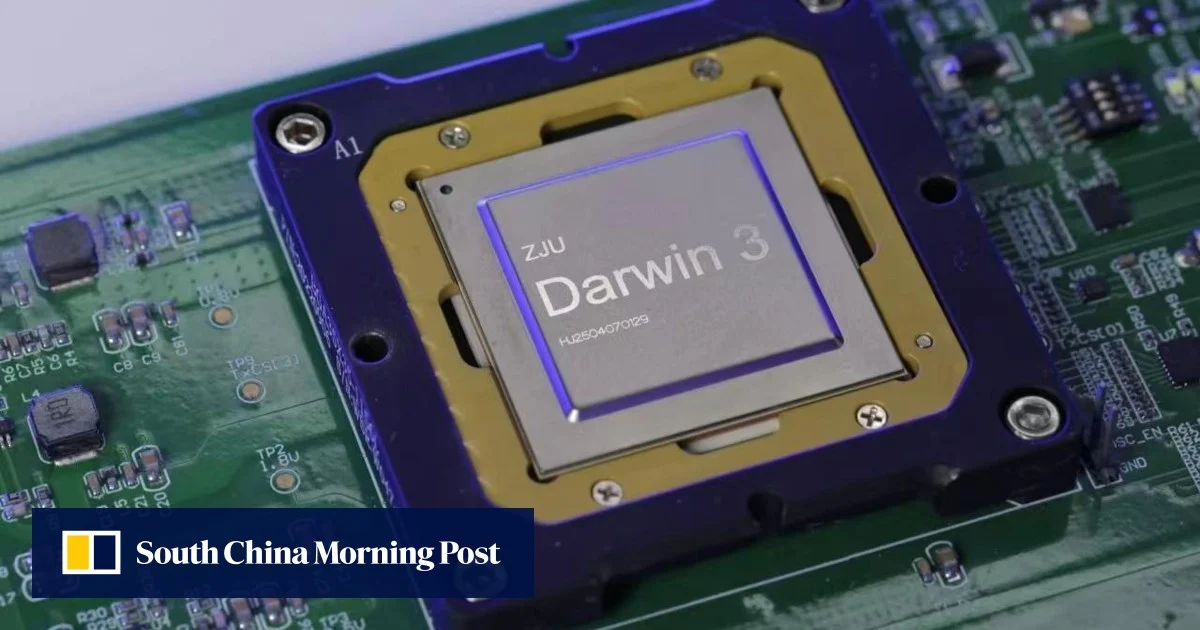
Chinese engineers at Zhejiang University have developed the 'Darwin Monkey,' the world's first brain-like computer with over 2 billion artificial neurons, potentially advancing human brain-inspired AI and capable of tasks like content generation and reasoning.