
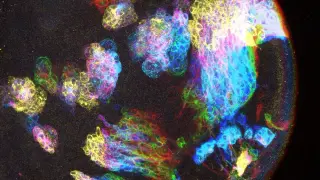
Developmental State May Explain Why Brain Regions Are More Cancer-Prone
Researchers studied fruit flies to understand why brain cancers arise preferentially in certain regions. By editing brain-cell identity proteins around Chinmo, they showed that the same cancer-causing mutation leads to tumors only in some areas; reducing Chinmo halted growth where tumors would form, while increasing Chinmo caused tumors in previously unaffected regions. The findings imply tumor formation depends on cell environment and developmental state, not just the mutation, offering potential therapeutic angles—though humans lack Chinmo, analogous proteins may influence susceptibility.