
New Jurassic Fossil Megacauda Reveals Ancient Origins of Mammalian Swallowing and Swimming
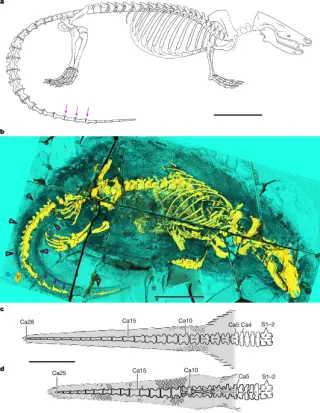
A newly described fossil, Megacauda sungei, from the Middle Jurassic of China represents the largest known mammaliaform of its era and the earliest evidence of semiaquatic behavior in the mammalian lineage. Discovered in 2015 in Inner Mongolia, the 168-to-163-million-year-old specimen preserves rare soft-tissue anatomy, including the pharyngeal vault and hyoid bones, confirming that the ability to swallow and suckle evolved before the rise of modern mammals. Weighing approximately 1 to 2 kilograms, this docodontan possessed webbed feet, a flattened tail, and carnivorous teeth, suggesting a lifestyle analogous to the modern platypus. The find fills a major gap in understanding early mammalian pelvic and hindlimb anatomy, indicating that semiaquatic niches were exploited by early mammal relatives long before the diversification of extant mammals.