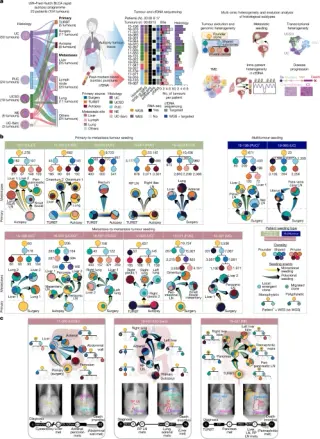
Rapid autopsy study reveals lethal bladder cancer subtypes evolve via metastasis-to-mastasis seeding
A large study using rapid autopsies of terminal bladder cancer patients reveals that metastatic spread is primarily driven by one metastasis seeding others, rather than the primary tumor. Plasmacytoid and neuroendocrine subtypes exhibit early aggressive genomic changes and shorter survival. Plasmacytoid tumors uniquely utilize the Fanconi anemia pathway to resist cisplatin, while polyclonal migration correlates with poor prognosis. Post-mortem cell-free DNA may enable non-invasive subtype identification.