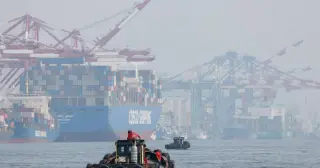
China expanded its maritime footprint beyond the First Island Chain with Maritime Safety Agency vessels conducting law-enforcement, seabed mapping, and alleged research east of Taiwan and near Scarborough Shoal, signaling de facto sovereignty ambitions and triggering concern among Taiwan, the United States and allies over regional stability and energy security.
Eyck Freymann argues the greatest danger to Taiwan isn’t a full-scale invasion but China’s gray-zone coercion—economic quarantines and controls that could sever Taiwan’s links to global trade while avoiding overt military conflict. The article urges the United States to deter a crisis, not just a war, by four pillars: political deterrence (deeper ties with Taiwan and a core coalition of allies), military readiness with asymmetric capabilities, strategic modernization (including nuclear and AI-enabled tools), and economic deterrence (an avalanche-decoupling approach and an economic security framework to rebalance dependencies). It also emphasizes planning for nonmilitary crisis management—evacuations, resupply, and resilient supply chains—so Washington can signal resolve without triggering panics, and it warns that a successful gray-zone strategy could icily reshape regional/global order if not countered with coordinated alliance action.