
Tag

Green Tree Ant

All articles tagged with #green tree ant

Australian ballista spider uses silk spring trap to hurl ants into its web
science3 hours ago

Australian ballista spider uses silk spring trap to hurl ants into its web

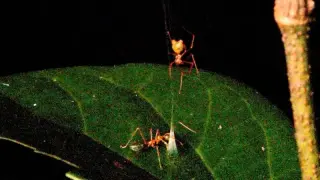
Researchers describe a newly found Australian spider, nicknamed the ballista spider, that builds a spring-loaded, cone-shaped silk trap to launch the green tree ant (Oecophylla smaragdina) into its main web. The 5–6 mm spider braids 15–60 tension lines into a cone attached to the surface; when an ant bites the cone, the silk detaches and snaps shut, flinging the ant upward with extreme speed and energy. The spider appears to specialize on this single prey species, suggesting a highly specialized evolutionary adaptation, and researchers captured the behavior in Cape York Peninsula using high-speed cameras.
Ballista spider hurls ants into a silk catapult web in Australia
science6 hours ago

Ballista spider hurls ants into a silk catapult web in Australia

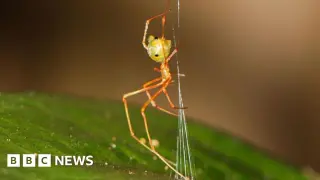
Australian researchers from Macquarie University describe a newly identified spider that uses a spring-loaded, catapult-like silk trap to catch only the aggressive green tree ant (Oecophylla smaragdina). Nicknamed the “ballista,” the spider builds a cone-shaped scaffold of tension lines, then launches a entangled ant into its web at extreme acceleration (about 15 g) when the ant bites the trap. The nocturnal predator hunts on trees in northern Queensland, potentially using pheromones to lure the specific ant while avoiding other prey. The discovery, documented in Current Biology, was made over ten nights with high-speed and infrared cameras by Ajay Narendra and colleagues from Macquarie University.

science19 hours ago

Australia's ballista spider hurls silk snare to ambush aggressive ants

A team describes the ballista spider (Propostira sp.) from Cape York, Australia, which builds a spring-loaded conical snare that is triggered by the green tree ant (Oecophylla smaragdina). The spider yanks ants into its core web at accelerations up to 1,367 m/s^2, then wraps and consumes them. The silk snare stores about 78 kJ per kilogram and can deliver roughly 11.7 MW of power, outperforming other known biological catapults. This extreme prey specialization and predation mechanism may rely on pheromones to attract the ants and represents a remarkable biomechanical adaptation.