
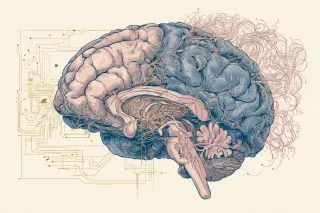
Disinhibition Circuit Enables Flexible Thinking and Lean AI
A Columbia Engineering team built biologically constrained recurrent neural networks and showed that an inhibition-on-inhibition circuit enables top-down control to reshape early visual processing based on task rules; weakening these connections collapses flexible switching, and live mouse cortex recordings validate the model's predictions, suggesting early sensory areas are dynamic workspaces and pointing to energy-efficient AI designs that mimic human cognitive flexibility.