Researchers at UC Santa Barbara unveiled a liquid solar battery that captures sunlight and stores it indefinitely in chemical bonds using a DNA-inspired pyrimidone molecule (MOST technology), releasing heat on demand. With an energy density of about 1.65 MJ/kg—roughly double that of lithium‑ion batteries—the system could heat homes or power off‑grid applications without relying on the electrical grid.
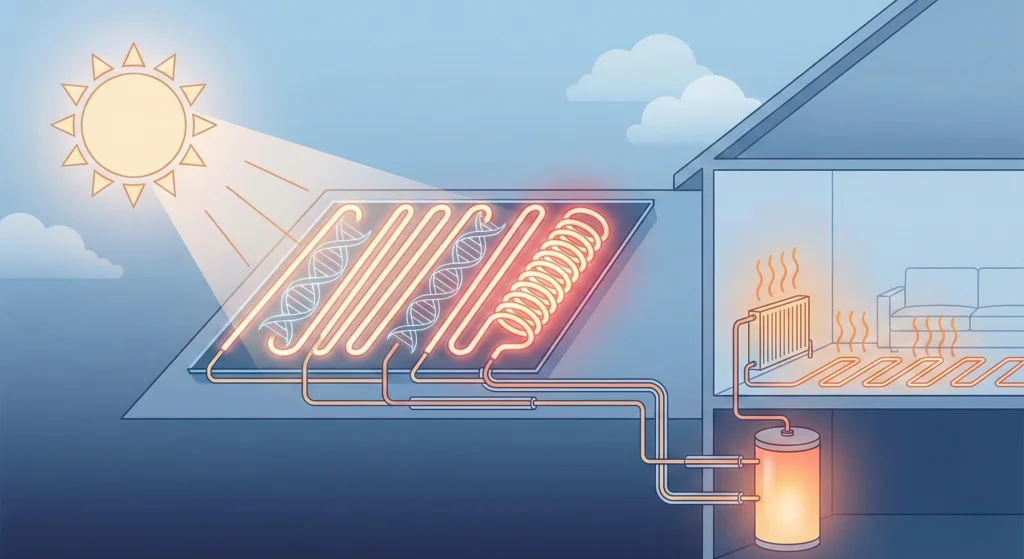
A UC Santa Barbara team has designed a pyrimidone molecule for molecular solar thermal (MOST) storage that traps sunlight and stores it as heat in a rechargeable, recyclable system. With an energy density above 1.6 MJ/kg—higher than typical Li-ion batteries—the molecule can absorb energy, hold it, and release heat on demand, potentially circulating in solar collectors to store daytime energy for later use without a separate battery.
Scientists at UCSB and UCLA built a liquid, solvent-free pyrimidone that absorbs sunlight, twists into a high-energy Dewar isomer, and stores energy in chemical bonds for later release as heat. In tests, it achieved an energy density of 1.65 MJ/kg—nearly twice that of typical lithium-ion batteries—and could boil water under ambient conditions, suggesting a potential closed-loop solar-heat system for winter. However, the molecule currently absorbs only UV-A/B (about 5% of solar energy) and has a low quantum yield, requiring extended sun exposure. The heat release relies on an acid catalyst, which would need a neutralization step in real systems. Despite these hurdles, with a projected long storage half-life (up to ~481 days) and no toxic solvent, the approach represents a promising step toward storing summer sunlight for cold months, though practical deployment remains years away.
A Science Magazine paper details Molecular Solar Thermal (MOST) energy storage that stores solar energy in UV-triggered molecular states (pyrimidone). It achieves about 1.65 MJ/kg energy density and can be liquid at room temperature, but heat release requires acidic conditions, complicating closed-loop use. The system exhibits self-discharge with a half-life up to roughly 481 days and supports only ~20 charge cycles, which limits practical cycling. While its energy density rivals Li‑ion batteries in theory, efficiency and cycling challenges mean it’s better suited for seasonal heat storage in sunny locations until further refinements improve viability.
UC Santa Barbara chemists report a bio-inspired pyrimidone molecule for molecular solar thermal (MOST) energy storage that captures sunlight, stores it in chemical bonds, and releases it as heat on demand. With an energy density over 1.6 MJ/kg—roughly twice that of lithium-ion batteries—the material can boil water under ambient conditions, enabling practical off-grid heating and solar-collector systems without bulky batteries. The approach functions like a rechargeable solar battery, with energy stored photochemically and released on trigger; the concept is reusable and recyclable and could transform how we store daytime sun for use later.
UC Santa Barbara researchers have developed pyrimidone, a water-soluble liquid that stores solar energy as heat in a reusable state, offering an energy-density advantage over lithium-ion batteries and enabling on-demand heating (even boiling water) without bulky storage, potentially transformative for off-grid solar uses.