
Nvidia Stock Volatility Persists Amid Huang's Return and AI Industry Debates
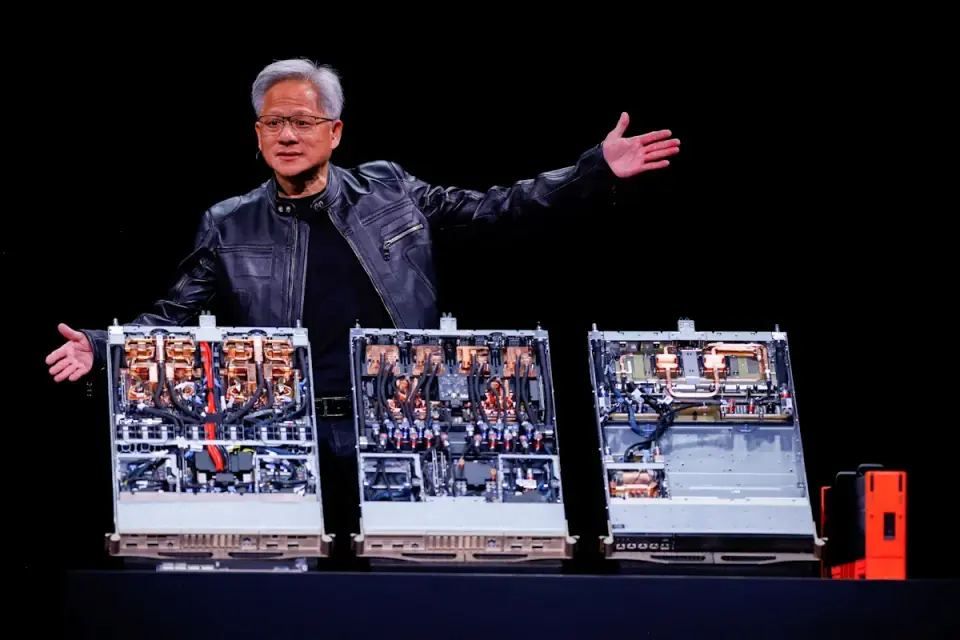
Nvidia shares remain volatile following CEO Jensen Huang's reinstatement, with analysts divided on whether the stock offers a buying opportunity or faces structural headwinds. While Huang's return restores founder-led leadership and the AI infrastructure spending cycle continues, concerns persist regarding corporate governance, rising competition from custom chips, and potential deflation in AI hardware costs. Recent fiscal Q3 results showed revenue of $115.8 billion, but investors are weighing these gains against valuation risks and the possibility that AI benefits may shift to companies using the technology rather than building it.
Key points
- Jensen Huang's reinstatement as CEO has restored founder-led leadership, which some analysts view as a positive for Nvidia's long-term strategy and sales capability, despite ongoing concerns about corporate governance standards.
- Nvidia reported fiscal Q3 2027 revenue of $115.8 billion, a 103% year-over-year increase, with data center revenue rising 110% to $107.6 billion, demonstrating continued strong demand for AI infrastructure.
- Critics argue that rising competition from custom chips by Alphabet and Amazon, along with a 92% annual drop in AI performance costs, could erode Nvidia's market share from 75% to 20-30% by 2028.
- Some investors view Nvidia as a 'generational buying opportunity' due to its low P/E ratio relative to projected 2028 earnings, while others warn that the stock may become a 'mediocre investment' as competition intensifies and growth slows.
- Nvidia has increased its quarterly dividend from 1 cent to 25 cents and authorized $230 billion in buybacks, signaling a shift toward returning cash to shareholders as growth opportunities may plateau.
Background
Nvidia's stock has been in focus since Jensen Huang's resignation and subsequent reinstatement in November 2026, which followed reports of personal misconduct and a 'Stand with Jensen' campaign. The company previously reached a $5 trillion market cap in 2025, driven by the AI boom. Broader market concerns include liquidity squeezes and high interest rates, which may impact AI companies' ability to sustain high investment costs. The current debate mirrors historical patterns where technology suppliers (like 19th-century coal miners) may not capture all the economic value generated by the technology's widespread adoption.
How outlets are covering it
Yahoo Finance emphasizes the positive impact of Huang's return, citing his unique understanding of the AI ecosystem and the continued strength of AI infrastructure spending, while acknowledging governance concerns. InvestorPlace presents a bearish view, comparing Nvidia to 19th-century coal miners who saw rising demand but falling profits due to competition and price deflation, suggesting that 'AI Outsiders' (companies using AI) may outperform Nvidia. The Korean outlet 재경일보 highlights a more cautious but ultimately positive outlook, with a professor noting that while volatility is expected, surviving companies like Nvidia could see stock price strength. Argus Research notes 'strong performance at an uncertain time,' reflecting the mixed sentiment among analysts.
Why it matters
Nvidia's trajectory is a bellwether for the entire AI industry. If the company can maintain its competitive advantage despite rising competition and price deflation, it will continue to dominate the AI infrastructure market. However, if its market share erodes as predicted, it could signal a shift in value toward companies that utilize AI rather than build it, potentially reshaping investment strategies and market leadership in the tech sector.
What to watch
Investors will closely watch Nvidia's upcoming GTC event in D.C., where Jensen Huang is expected to present, as a key indicator of the company's strategic direction. Market attention will also focus on how Nvidia navigates rising competition from custom chips and whether its recent dividend and buyback initiatives can sustain shareholder value. Broader AI industry trends, including potential volatility in 2027 due to high interest rates and investment costs, will also influence Nvidia's stock performance.
- Is Nvidia a generational buying opportunity — or the AI trade's biggest trap? Yahoo Finance
- Nvidia Could Keep Growing and Still Disappoint Investors InvestorPlace
- AI Sector Funding Slumps Amid Tech Selloff, Nvidia (NVDA) Stands Out GuruFocus
- Hong Jin-kyung asks, "Should I buy Nvidia again?"... Professor says, "It's not bad"... Concerns of a crisis in the AI industry next year despite Nvidia's $115.8 billion in revenue 재경일보
- NVIDIA Corporation (NVDA) Stock Forecasts Yahoo! Finance Canada
Want the full story? Read the original reporting
Read on Yahoo Finance