
PHP Foundation Releases Patches for 18 Vulnerabilities, Including Seven Critical RCE Flaws
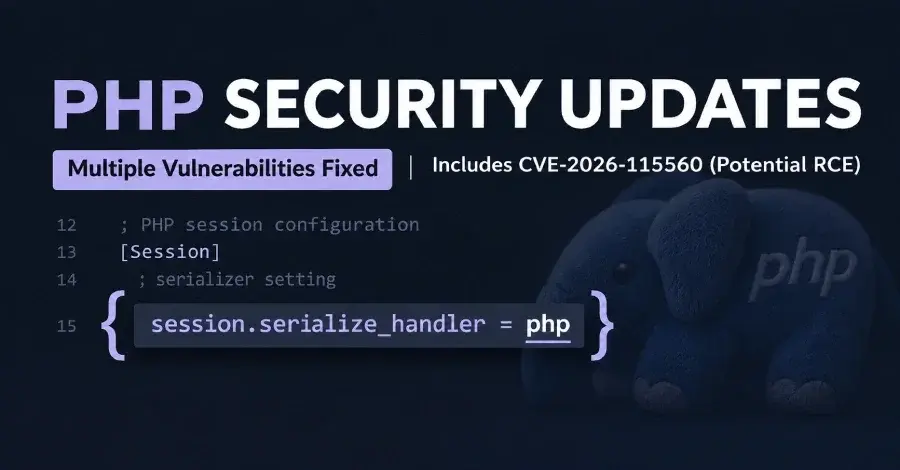
The PHP Foundation released security updates on November 19, 2026, addressing 18 vulnerabilities, seven of which are critical. The most severe flaws, including CVE-2026-115560 and CVE-2026-126714, enable remote code execution under specific non-default configurations. Patches are available for PHP versions 8.2.36 through 8.6.0, following a month of active exploitation of earlier 'PHP2Shell' bugs.
Key points
- PHP released patches for 18 vulnerabilities, with seven rated critical (CVSS 9.2).
- CVE-2026-115560 allows remote code execution via session upload progress in specific configurations.
- CVE-2026-126714, dubbed 'phpAfterShell,' exploits interrupted session writes to achieve code execution.
- Patches are available for PHP 8.2.36, 8.3.37, 8.4.28, 8.5.13, and 8.6.0.
- The update follows active exploitation of the earlier 'PHP2Shell' vulnerabilities in October 2026.
Background
This release follows the October 2026 emergency patch for 'PHP2Shell' (CVE-2026-109618 and CVE-2026-109619), which were leaked before disclosure and subsequently exploited in the wild. The current update is part of PHP's regular four-week release cycle, addressing flaws that were disclosed in advance on November 18, 2026.
How outlets are covering it
The Hacker News emphasizes the technical complexity of exploitation, noting that critical flaws require non-default configurations or uncommon setups. SecurityWeek highlights the timing, noting that CVE-2026-115560 was disclosed two days after the PHP2Shell patches. Infosecurity Magazine provides the broadest scope, detailing all 18 vulnerabilities and noting that downstream projects like Laravel and FrankenPHP are already integrating the fixes. All sources agree that immediate patching is advised, with mitigation options like disabling session upload progress for those unable to update immediately.
Why it matters
PHP powers a significant portion of the web, and these critical flaws could allow attackers to execute arbitrary code, access sensitive data, or disrupt services. The recent exploitation of PHP2Shell demonstrates the real-world risk of unpatched PHP installations, making timely updates crucial for security.
What to watch
Users should update to the latest patched versions immediately. If immediate patching is not possible, disabling session upload progress is recommended as a mitigation. Downstream projects are expected to release updated builds soon.
- PHP Fixes 7 Critical Flaws, Including Bugs That Could Allow Remote Code Execution The Hacker News
- PHP Warns of Critical Security Flaws Affecting All Supported Versions, Fixes Coming November 19 The Hacker News
- AI Found A Second Critical Hole In The Code Running 70% Of The Web Forbes
- PHP Readies Critical Security Updates to Patch Another RCE Flaw SecurityWeek
- PHP Releases Patches to Fix 18 Vulnerabilities Infosecurity Magazine
Want the full story? Read the original reporting
Read on The Hacker News