
US Army Awards $7B in Counter-Drone Contracts to 10 Firms
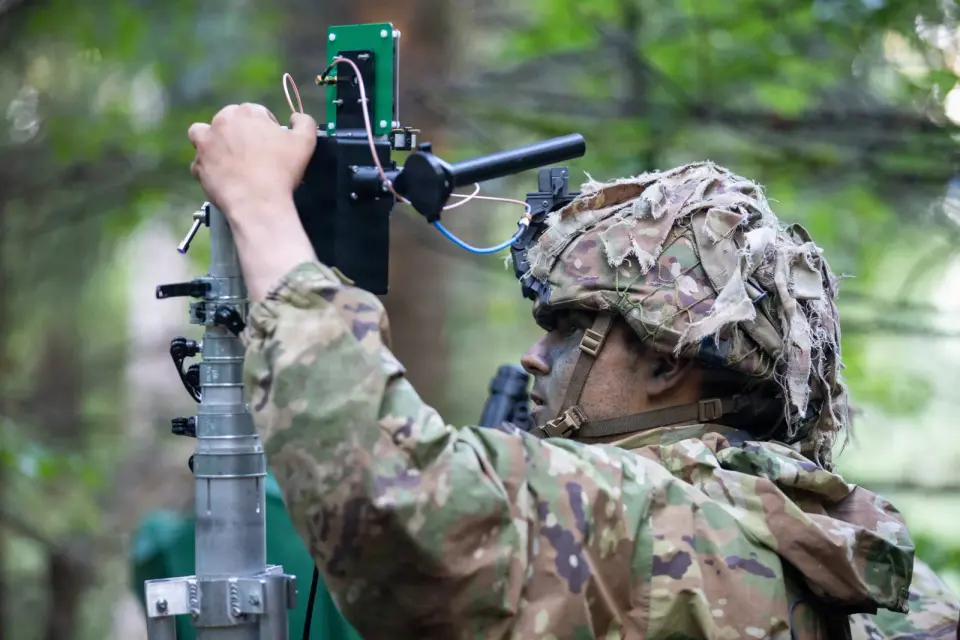
The US Army has awarded indefinite delivery, indefinite quantity (IDIQ) contracts worth up to $7 billion to ten companies for counter-drone technologies. The contracts, announced by Joint Interagency Task Force 401 (JIATF-401), cover sensors, effectors, and command-and-control systems. Officials emphasized a 'layered defense' approach rather than relying on a single solution, aiming to support the Pentagon's drone marketplace and the Domestic Shield program for protecting critical infrastructure.
Key points
- The Army awarded IDIQ contracts to 10 companies, including Allen Control Systems, DroneShield, and L3Harris, with base values ranging from $150 million to $500 million.
- JIATF-401 officials stated there is no 'silver bullet' for counter-drone defense, necessitating a mix of interoperable systems for detection, tracking, and mitigation.
- The contracts support the Pentagon's drone and counter-drone marketplace, which has already generated over $800 million in sales, and the Domestic Shield program for protecting US installations.
- A memorandum of understanding was signed between JIATF-401 and the National Nuclear Security Administration to share data on drone threats and reduce duplicative testing.
- The Australian Financial Review noted that DroneShield's stock rose 5.3% following the announcement of its $500 million contract with the US Army.
Background
This development follows recent shifts in US Army drone strategy, including the dismantling of a Europe-based drone warfare unit in August 2026 and congressional inquiries into paused drone warfare initiatives. Earlier this month, the Army deployed approximately 2,000 autonomous drones during the Saber Junction exercise in Germany, highlighting a move toward treating drones as replaceable munitions. The new contracts aim to address the growing threat of small drones, which have killed US service members in recent conflicts, by scaling production and availability across federal agencies and allied nations.
How outlets are covering it
Breaking Defense and Business Insider both highlight the strategic shift toward a 'layered defense' and the rejection of a single-vendor approach, with JIATF-401 officials emphasizing competition and interoperability. Business Insider notes the urgency driven by conflicts in Ukraine and incidents in Kuwait and Jordan. The Australian Financial Review focuses on the market impact, specifically the stock price surge for DroneShield. Defense Daily provides background on related exercises like Scarlet Dragon 26.3, which tested similar sensor and command-and-control architectures, though it does not directly cover the new contract awards. All sources agree on the $7 billion value and the involvement of JIATF-401, but Breaking Defense provides the most detailed breakdown of individual contract values, while Business Insider contextualizes the broader threat environment.
Why it matters
The $7 billion IDIQ award signals a major commitment by the US government to diversify its counter-drone capabilities, moving away from single-system solutions. This approach aims to address the rapidly evolving threat of small drones, which pose risks to military installations and critical infrastructure. By supporting a marketplace model, the Army seeks to scale production, reduce costs, and ensure rapid deployment of effective technologies across federal agencies and allied nations, potentially influencing global defense procurement trends.
What to watch
The Army plans to utilize multiple acquisition channels, including commercial solutions openings and the Pentagon's drone marketplace, to facilitate further buys. JIATF-401 officials expect the counter-drone marketplace to scale similarly to the existing drone marketplace, which has already exceeded $800 million in sales. The signed memorandum of understanding with the National Nuclear Security Administration will lead to shared data on drone threats, potentially accelerating the fielding of new capabilities. Future announcements may detail specific delivery timelines and recipients for the awarded contracts, as well as the expansion of the marketplace to additional international partners.
- Army awards up to $7B in sprawling counter-drone IDIQ Breaking Defense
- ASX 200 LIVE: ASX to slip; DroneShield secures $716m US army contract AFR
- A US military task force just showed it's ready to bet billions of dollars on answers to the drone problem Business Insider
- Col. Rob Kinney, Chief of Fires, XVIII Airborne Corps, Discusses Scarlet Dragon 26.3 Defense Daily
- DroneShield Awarded US$500M IDIQ Contract for US Homeland Counter-Drone Programme Kalkine
Want the full story? Read the original reporting
Read on Breaking Defense