
Census Data Shows AI Adoption Has Not Yet Reduced Overall Employment
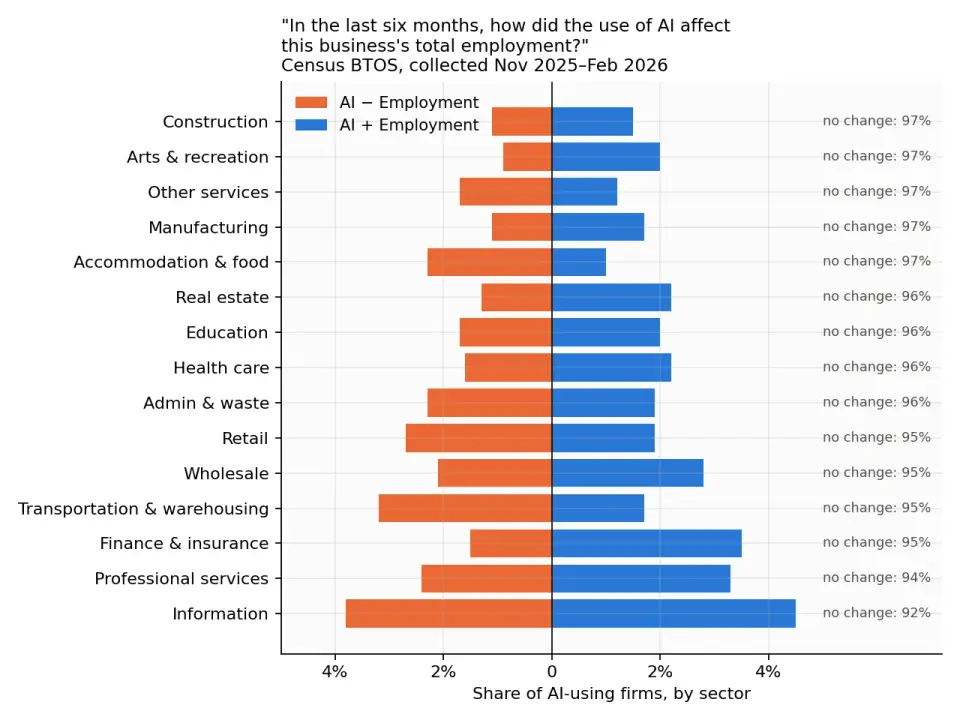
New Census Bureau data indicates that while AI adoption has risen to 18% of businesses, it has not significantly impacted total employment levels. However, entry-level roles in marketing and legal are facing increased automation exposure, shifting the nature of junior work rather than eliminating it entirely.
Key points
- Census Bureau surveys show 95.7% of firms reported no change in total employment despite rising AI adoption.
- AI usage in businesses jumped from 3.7% in 2023 to 18% in late 2025 when measuring any business function.
- Entry-level roles in marketing and legal are more exposed to AI automation than engineering or customer service roles.
- Reshaped entry-level jobs now demand senior-level skills, with openings growing 35% since 2019.
- South Carolina is implementing AI fellowships and apprenticeships to help junior workers adapt to automated tasks.
Background
In 2023, the U.S. Census Bureau began tracking AI usage in its Business Trends and Outlook Survey. Early concerns from tech leaders predicted rapid job displacement, but subsequent data has shown a more gradual integration of AI into existing workflows rather than mass replacement of workers.
How outlets are covering it
Marginal Revolution highlights Census data showing minimal employment impact, noting that 95.7% of firms reported no change in headcount despite AI adoption reaching 18%. The Post and Courier emphasizes the risk to career ladders, arguing that AI automates beginner tasks faster than companies redesign developmental roles, potentially stalling junior worker progression. The Ritz Herald counters the narrative that AI targets engineers first, citing Coresignal data that shows marketing and legal entry-level roles are far more exposed to automation than technical roles, with junior positions now requiring senior-level judgment.
Why it matters
The data suggests AI is currently augmenting rather than replacing labor at the firm level, but it is reshaping the requirements for entry-level positions. This shift could create a barrier for new graduates in non-technical fields, necessitating updated training and apprenticeship models to maintain workforce development pipelines.
What to watch
Employers and educational institutions will likely continue adapting entry-level job requirements to include AI-augmented skills. Monitoring of sector-specific employment trends, particularly in marketing and legal, will be crucial to determine if the current lack of employment impact persists as AI capabilities expand.
- AI and Employment: So Far, So Good Marginal REVOLUTION
- AI Isn’t Coming for Our Jobs. It’s Coming for Our Wages. Jacobin
- Commentary: AI is removing the first rung of South Carolina’s career ladder Post and Courier
- CNBC and SurveyMonkey Release Insights on AI’s Impact on Jobs in Q3 2026 Small Business Trends
- The AI Squeeze on Entry-Level Work Is Landing on Marketing and Legal, Not Engineering The Ritz Herald
Want the full story? Read the original reporting
Read on Marginal REVOLUTION