
China Q3 Growth Hits 4.5% as AI Exports Offset Property Slump
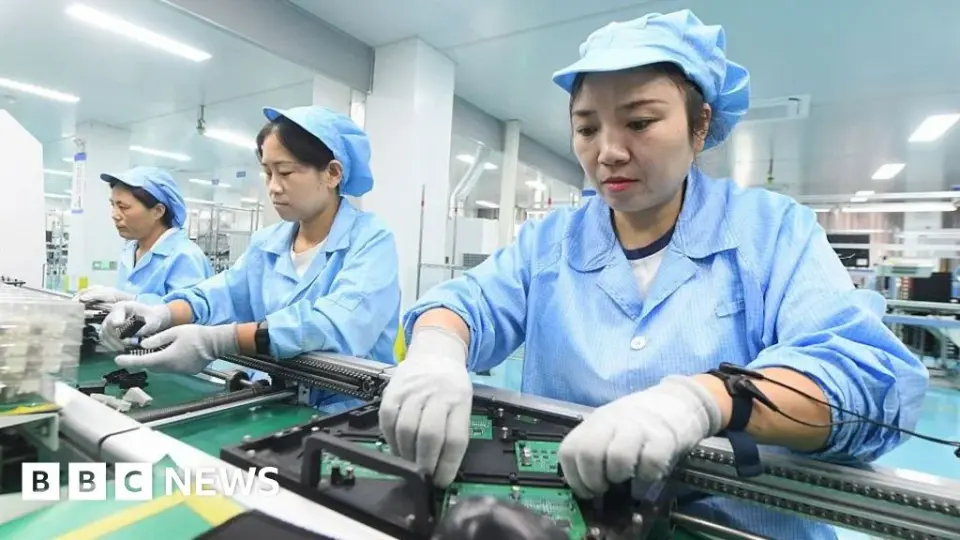
China’s third-quarter GDP growth accelerated to 4.5%, rebounding from a three-year low of 4.3% in the previous quarter. This expansion, which beat economist forecasts of 4.4%, was driven by a surge in artificial intelligence and high-tech exports. However, domestic weakness persists, with property investment falling over 20% in the first nine months and retail sales growing only 1.1% in September. The trade surplus is on track to exceed the previous year’s record of $1.2 trillion, though global trade tensions and cooling AI investment sentiment pose risks to future growth.
Key points
- Q3 GDP growth reached 4.5%, up from 4.3% in Q2, but below the 5% growth seen in Q1.
- Fixed asset investment in urban areas declined 7.2% year-on-year for the first nine months.
- Property investment dropped more than 20% in the first nine months compared to the same period last year.
- September retail sales grew 1.1%, exceeding forecasts, while industrial output rose 5.5%.
- The urban unemployment rate stood at 5.2% in September.
- China’s trade surplus is projected to surpass the previous year’s record of $1.2 trillion.
Background
Recent months have shown China relying heavily on external demand to offset domestic consumption weakness. In August, the trade surplus hit a record $119 billion, driven by a 25% jump in exports. This trend aligns with the current Q3 data, where manufacturing and high-tech exports continue to buffer against a deepening property slump and sluggish consumer spending. The broader global context includes escalating trade tensions, particularly with the European Union, which adds uncertainty to China’s export-driven growth model.
How outlets are covering it
BBC and CNBC both highlight the acceleration in Q3 growth to 4.5%, but emphasize different drivers. BBC focuses on the AI boom and high-tech exports as the primary offset for domestic weakness, noting that the trade surplus is on track to exceed last year’s record. CNBC provides more granular data, detailing the 7.2% decline in fixed asset investment and the 1.1% growth in retail sales, while also noting that economists expected a 4.4% growth rate. Both outlets agree that the economy is leaning on factories and overseas buyers, but CNBC specifically mentions the cooling of AI-related sector investments and escalating EU trade tensions as future risks. BBC cites Oxford Economics researcher Sheana Yue on the role of manufacturing and high-tech exports, while CNBC notes the policy response, including rate cuts and debt quota allocations, to address domestic weakness.
Why it matters
The 4.5% growth rate, while an improvement, remains at the lower end of Beijing’s 4.5%-5% annual target, signaling limited room for policymakers to address economic challenges. The reliance on exports, particularly in AI and high-tech sectors, highlights a structural imbalance in the Chinese economy, with domestic consumption and investment remaining weak. The deepening property slump and declining fixed asset investment suggest that the current growth is not sustainable without significant policy intervention. As global trade tensions escalate and AI investment sentiment cools, China’s ability to maintain this growth trajectory is uncertain, potentially impacting global supply chains and trade balances.
What to watch
Economists expect the People’s Bank of China to hold benchmark lending rates unchanged through the rest of 2026, leaving fiscal measures to drive economic support. Beijing’s allocation of 550 billion yuan of unused debt quota to local governments and targeted rate cuts in late September indicate a shift toward fiscal stimulus. However, the cooling of AI-related investments and escalating trade tensions with the EU may limit the effectiveness of these measures. Future growth will depend on whether domestic consumption can recover and whether export demand remains strong despite global uncertainties.
- China's economic growth picks up as AI boom boosts exports BBC
- China’s Growth Rebounds to 4.5%, Puts Annual Target Within Reach Bloomberg.com
- China's third-quarter economic growth quickens to 4.5% as exports surge, beating estimates CNBC
- China’s economy expands 4.5% in third quarter Financial Times
- Tardy China Stimulus Sets Up Second Quarter of Sub-Target Growth Bloomberg.com
Want the full story? Read the original reporting
Read on BBC