
Seattle Mayor Wilson Signs 'Seawall' Order to Diversify Economy Away from Big Tech
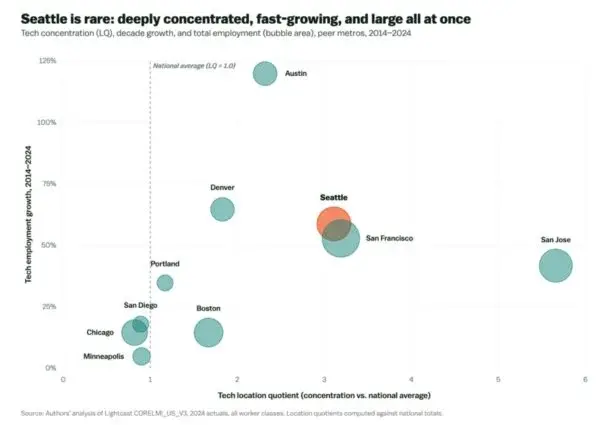
Mayor Katie Wilson signed an executive order to diversify Seattle’s economy, which currently relies heavily on a few large tech firms. The plan, dubbed 'Seawall,' aims to support mid-sized businesses, reduce permitting barriers, and create a new economic task force to address high living costs and job growth stagnation.
Key points
- Mayor Katie Wilson signed an executive order to diversify Seattle’s economy, which currently relies heavily on a few large tech firms.
- The plan, dubbed 'Seawall,' aims to support mid-sized businesses, reduce permitting barriers, and create a new economic task force.
- Data shows companies with 100+ workers drove 74.5% of Seattle’s net job growth from 2014 to 2023, far exceeding the national average.
- Mid-sized employers generated only 16.6% of local job growth, lagging behind peer cities like San Diego and Austin.
- A couple with two children in Seattle needs 91.5% more income to cover basic expenses than a childless couple, the highest gap outside the Bay Area.
- The order directs the creation of a Resilient Seattle Economy Task Force, led by Beto Yarce, to hold sector-specific roundtables.
Background
This move follows a Business Climate Assessment report commissioned by the previous administration, which highlighted Seattle’s vulnerability to shocks from large corporate giants. The city has been grappling with high living costs and a narrow tech pipeline, where only four companies account for 25% of software-engineering demand. Recent archive coverage notes broader city challenges, including public safety concerns and infrastructure issues, but this executive order specifically targets economic resilience and business retention.
How outlets are covering it
CHS Capitol Hill Seattle News emphasizes the need to cultivate mid-sized businesses and reduce reliance on big tech, citing specific job growth and cost-of-living data. KUOW highlights the risk of AI disruption and the outflow of mid-sized firms to cities like San Francisco and Austin, noting that venture capital is flowing to the Bay Area instead of Seattle. KOMO focuses on the 'fragile' economic moment, tech layoffs, and office vacancies, while questioning the funding source for the new initiatives, especially given a $175 million deficit in 2027. Downtown Seattle Association CEO Jon Scholes, quoted by both KUOW and KOMO, called Seattle’s economy 'sluggish' and warned against new business taxes, stating that more taxes would lead to fewer jobs.
Why it matters
Seattle’s economy is at risk of systemic disruption due to its heavy reliance on a few large tech firms. Diversifying the economic base through mid-sized businesses and new industries could stabilize job growth, reduce the cost-of-living burden on families, and make the city more competitive against peer cities like Austin and Denver. The success of this plan could determine whether Seattle retains its status as an innovation hub or loses momentum to other regions.
What to watch
The Resilient Seattle Economy Task Force will begin meeting next month, with initial recommendations to the mayor in February and final recommendations in one year. The city will also work on fast-tracking permitting and opening public assets to emerging enterprises. The funding source for the Seattle Strategic Initiatives Fund remains to be determined, and the city faces a $175 million deficit in 2027.
- ‘Seawall’ — After long reliance on big tech, Seattle mayor orders pivot to cultivate mid-sized businesses CHS Capitol Hill Seattle News
- City of Seattle unveils economic plan as office vacancies hit hard KING5.com
- Seattle's sluggish economy and Mayor Wilson's plan to goose it KUOW
- Seattle mayor wants fund for startups after report cites tech job instability The Center Square
- Seattle mayor launches task force as city faces 'fragile' economic moment KOMO
Want the full story? Read the original reporting
Read on CHS Capitol Hill Seattle News