
US Deficit Approaches $2 Trillion as Record Interest Costs Strain Fiscal Outlook
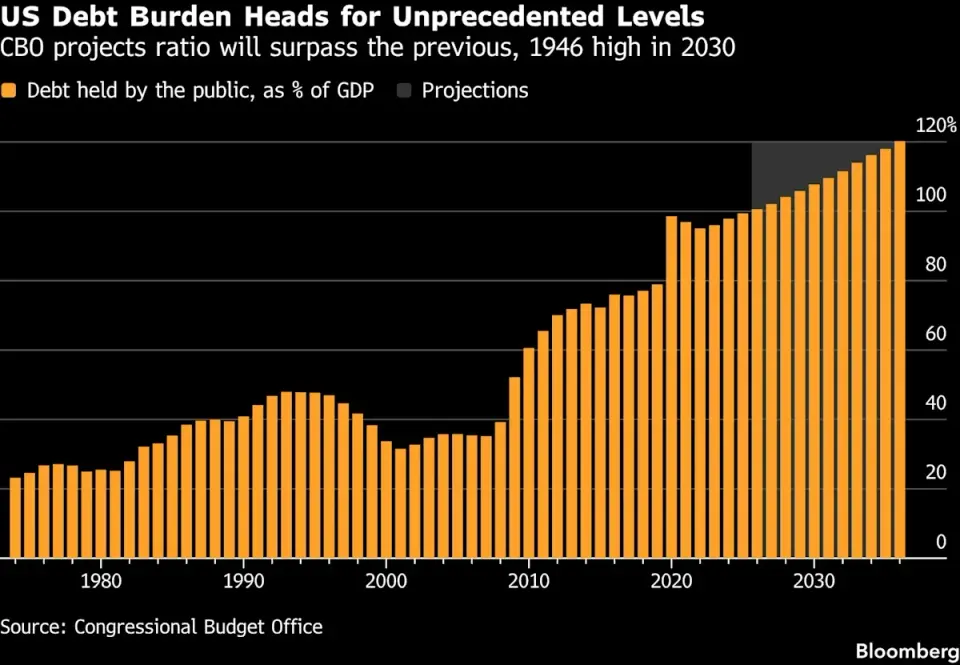
The US federal budget deficit is nearing $2 trillion for fiscal 2026, driven by record net interest costs of $1.05 trillion. While the Trump administration promised spending cuts, rising borrowing costs and military expenditures have outpaced reductions, raising concerns about long-term fiscal sustainability despite strong nominal GDP growth.
Key points
- Net interest costs reached $1.05 trillion in fiscal 2026, up 8% from $970 billion in fiscal 2025.
- The US budget deficit is approaching $2 trillion, its highest level since the pandemic, according to the New York Times.
- Average interest rates on marketable Treasuries rose to 3.52% by September 2026, more than double the 1.47% rate five years prior.
- The Congressional Budget Office projects the debt-to-GDP ratio will exceed 106% by 2030.
- Nominal GDP growth of 6.3% in the second quarter currently outpaces Treasury yields, mitigting immediate crisis risks.
Background
This follows earlier reports in October 2026 where Treasury officials dismissed IMF warnings about fiscal crisis, arguing that growth could resolve debt issues despite yields above 5%. Global debt had also reached $365 trillion in mid-2026, with advanced economies spending more on interest than on AI or defense.
How outlets are covering it
Bloomberg and the Congressional Budget Office emphasize the structural risk of a 'snowballing' debt burden, with CBO Director Phillip Swagel warning of a 'turbocharger effect' if negative shocks raise rates. The New York Times frames the near-$2 trillion deficit as a reality check for the Trump administration's cost-cutting promises, noting that spending on the military and safety net has dwarfed reductions. While economists like Louise Sheiner describe the situation as a 'slow eating away' of fiscal capacity rather than an immediate crisis, TD Securities notes that nominal GDP growth currently provides a buffer against a fiscal apocalypse.
Why it matters
Record interest costs now rank among the top three federal outlays, behind only Social Security and Medicare. If lenders withdraw support, the US could face a fiscal crisis, while rising borrowing costs impact mortgages, credit cards, and auto loans for consumers.
What to watch
The Treasury Department will release final GDP figures for the fourth quarter later this month, which will determine if interest costs surpass 3.2% of GDP. Market participants will monitor whether the current high yields sustain demand for debt auctions or trigger a shift in lender behavior.
- US Interest Costs Hit Record $1 Trillion, Risking Debt Snowball Yahoo Finance
- US debt interest costs hit $3 billion a day and jumped 8% in 2026—faster than spending, revenue, GDP Fortune
- The US federal budget deficit for 2026 just came in. It’s $1.992 trillion. Yahoo Finance
- US annual budget gap hits nearly $2 trillion, largest in 5 years Reuters
- U.S. Budget Deficit Nears $2 Trillion, a Reality Check for Trump’s Cost Cutting The New York Times
Want the full story? Read the original reporting
Read on Yahoo Finance