
Brent Crude Hits $117 Amid Hormuz Tensions and Depleted Reserves
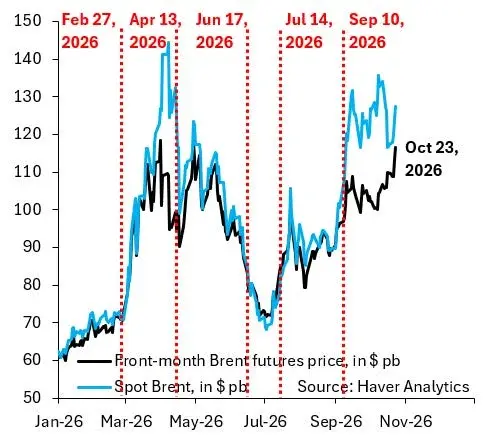
Brent crude prices have reached $117 per barrel, nearing the year's peak, driven by renewed tensions in the Strait of Hormuz and Houthi attacks on shipping. While supply from the Persian Gulf has largely normalized, analysts debate whether current prices reflect excessive risk premiums or genuine demand. Global strategic oil reserves remain at historic lows following massive releases earlier this year, raising concerns about the world's ability to withstand a prolonged supply disruption.
Key points
- Brent crude rose to $117 per barrel, approaching the March high of $118, with front-month futures up 90% since the start of 2026.
- Robin J Brooks argues the price hike reflects an excessive risk premium for potential war, noting that Gulf supply has returned to near pre-war levels of 20 million barrels per day.
- Al Jazeera reports that global strategic reserves have fallen by nearly 327 million barrels since late 2025, leaving only about 400 million barrels of usable stock outside China and the Gulf.
- Houthi attacks have targeted tankers in the Strait of Hormuz and Bab al-Mandeb, with Iran's IRGC claiming hits on multiple vessels, though Washington dismissed some claims.
- Analysts warn that a full closure of key chokepoints could reduce Middle Eastern exports to 7.5 million barrels per day, a shortfall of 9.3 million barrels per day that reserves cannot fully cover.
Background
Oil markets experienced significant volatility earlier this year following the US-Israel war on Iran, which began in late February. During that period, Brent prices spiked as the IEA coordinated the release of 400 million barrels from emergency supplies, more than double the volume released after the 2022 invasion of Ukraine. The US Strategic Petroleum Reserve has since fallen to 283 million barrels, its lowest level since 1982. Recent data shows crude demand in major Asian economies returning to pre-war levels, but prices remain elevated due to geopolitical fears rather than fundamental demand shifts.
How outlets are covering it
Robin J Brooks, writing for Substack, contends that the current price surge is driven by an excessive risk premium rather than actual supply shortages or strong demand. He notes that Gulf supply has normalized and that the December 2027 futures price remains stable, suggesting the spike is short-term. In contrast, Al Jazeera highlights the physical constraints of the market, emphasizing that global reserves are critically low and that a renewed conflict could lead to severe supply disruptions. Al Jazeera cites analysts who warn that reserves would last only weeks in a full closure scenario, potentially pushing prices to $150 per barrel. While Brooks views the current pricing as irrational, Al Jazeera focuses on the tangible risks of depleted stockpiles and logistical bottlenecks in alternative supply routes.
Why it matters
The current oil price levels and depleted reserves pose significant risks to global economic stability. If tensions escalate further, the world may lack the buffer to absorb supply shocks, leading to sharp price spikes that could trigger demand destruction and inflationary pressures. Asian importers, particularly India and Pakistan, are most vulnerable due to thin reserves and long shipping times for alternative supplies. The situation underscores the fragility of global energy infrastructure and the limited capacity of strategic reserves to mitigate future disruptions.
What to watch
Markets will closely monitor developments in the Strait of Hormuz and Bab al-Mandeb, as well as any diplomatic efforts to end the US-Iran conflict. If tensions de-escalate, Brent prices may fall toward the $90 level, reflecting a more normalized risk premium. However, if attacks continue or a full closure occurs, prices could spike to $125 or higher, with potential for $150 if supply disruptions persist. Governments may need to release additional reserves or implement demand-side measures to manage the impact on consumers and industries.
- What’s Priced into Brent at $117? Robin J Brooks | Substack
- Oil prices jump $3 on Houthi attacks, oil spill, highest settlement since April Reuters
- Global Oil Price Hits $116 a Barrel, Highest Since April The New York Times
- Are global oil reserves sufficient to withstand renewed US-Iran war? Al Jazeera
- Oil Prices Rise on Fears of Middle East Conflict Escalation WSJ
Want the full story? Read the original reporting
Read on Robin J Brooks | Substack